Introduction
Homo sapiens is the scientific name given to human beings. The term Homo sapiens was given by Carl Linnaeus, the father of Taxonomy. In Latin, the term Homo refers to ‘earthly being’ and sapiens refers to ‘wise’.
We are the sole surviving members of the genus Homo. We are bestowed with a higher cognitive function than every other living being on earth. Also, we are the most destructive species on this planet given our failure to practice rectitude at times.
Taxonomic Tree of Human Beings
The taxonomic tree of human beings based on hierarchical categories from kingdom to species is presented below.
- Kingdom:Animalia: It includes multicellular organisms i.e., cells containing a nucleus and membranes with no cell walls.
- Phylum: Chordata: It includes mammals possessing a spinal cord.
- Class:Mammali: It includes chordates that are warm-blooded and give birth to live prodigies instead of eggs. The females of the taxa have mammary glands that secrete milk to provide necessary nutrients to the new-born.
- Order:Primates: Primates are mammals with collar bones, eyes facing forward, hands with fingers capable of grasping, and dual kinds of teeth i.e., incisors and molars. Incisors are the four front teeth of the upper and lower jaws used to cut food. The remaining posterior teeth in the mouth are called the molars. They are broad and flat with the largest crown than any other teeth. Their primary role is to grind food.
- Family:Hominidae: Hominidae is primates with a large brain, flat faces, stereoscopic vision, upright posture, and different use of hands and feet in contrast to most animals.
- Genus: Homo: This taxon includes hominids with S-curved spines. Most common and probably the only living example is a human.
- Species:Homo sapiens: Homo sapiens are humans characterized by a high forehead, thin skull bones, and well-developed chin.
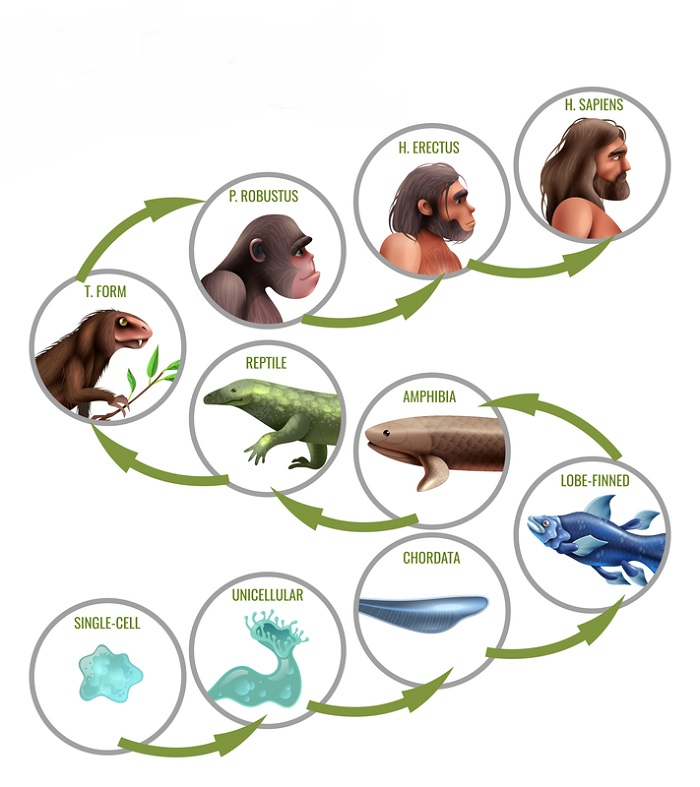
Image: Human evolution with development stages from single cell to sapiens
Explore our latest online courses and learn new skills at your own pace. Enroll and become a certified expert to boost your career.
General Features of Human Beings
The physical characteristics of human beings vary based on their demographics as environmental factors affect these characteristics largely.
| S. No. | Name of the Characteristic | Human Being |
|---|---|---|
| 1 | Color | Brown, White, Wheatish, Tan, Black. |
| 2 | Skin Type | Smooth |
| 3 | Average lifespan | 60-80 years |
| 4 | Average running speed | 6.5-8.5 miles per hour |
| 5 | WeightMale adultsFemale adults | 154-183 lbs119-141 lbs |
| 6 | HeightMale adultsFemale adults | 5”7’5”2’ |
| 7 | Pedals | Bipedal |
| 8 | Habitat | 6 continents out of the 7 |
| 9 | Diet | Omnivores. |
Some fascinating facts about Homo sapiens are as follows:
- Our closest living relatives are chimpanzees, bonobos, and gorillas.
- We share nearly 95-99% identical DNA with the chimpanzees.
- We are presumed to split from apes in terms of evolution, some four to eight million years ago.
- It is estimated that we began to form cultural heritage including language, dance, and music some three hundred thousand years ago.
- We have less hair than an average ape despite having more hair follicles than them.
- We have a much greater number of sweat glands, nearly 20 lakhs.
- Amongst the primates, we possess the smallest teeth.
- We are the only primates to have a chin.
- Our nose is capable of distinguishing between 1 trillion smells.
- We have hands with fingers and opposable thumbs.
- Our feet are the most ticklish parts of our body.
- Our belly button has a special kind of hair designed to trap the lint.
- According to studies, 61% of humans live in Asia, 14% in the United States of America, 14% in Africa, 11% in Europe, and 0.5% in Oceania.
- We can consume vegetables, fruits, dairy products, meat, and fish.
- About 8% of the human population is vegetarian i.e. consumes fruits, vegetables, and dairy only.
- Out of this 8%, about 0.5% are vegan and do not consume dairy also.
Different Races
A race is a categorization of humans based on shared physical or social traits into distinct groups within a community.
According to a classification made by Carleton S Coon (1962), human beings can be categorized into four major races namely White or Caucasian, Australoid, Mongoloid/ Asian, and Negroid/Black. Although the word ‘race’ is no longer used and has been replaced by a more sensitive term ethnic groups.
History
The term ‘race’ came into day-to-day usage during the 15th century to categorize people based on variations and similarities, particularly those from close kinship relations.
By the 17th century, the term race was used to group people based on phenotypical traits followed by nationality later. Although races are used to classify people based on physical similarities, they do not have any physical or biological significance. Albeit, race has become a means for differentiation amongst societies as the superiority of one race over the other.