When water is added to cement, the ingredients of cement react chemically with water and form a complicated chemical compound. The mixing of cement with water results in a sticky cement paste and it gradually goes on thickening in course of time. It is found that ordinary cement achieves 70 per cent of its final strength in 20 days and 90 per cent in 1 year or so.
The time of setting is greatly influenced by the following factors:
- The temperature at which the cement paste is allowed to set.
- The percentage of water mixed to cement in making the paste.
- The humidity at which the setting is allowed.
Setting time is distinguished into initial setting time and final setting time on the basis of the time taken by the test specimen to set to a specified minimum depth.
A Vicat needle apparatus is used for the determination of setting time (Figure 4.1).
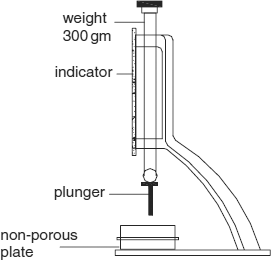
Figure 4.1 Vicat apparatus
Apparatus
- It consists of a frame with a movable rod fitted with a cap.
- A needle of 1 mm square cross section is attached to the lower end of the rod for the determination of initial setting time. The total weight of the rod along with the needle is 300 g.
- Another needle like the above mentioned but with a hollow metallic attachment with a circular cutting edge of 5 mm diameter and having a 0.5 mm projection at the end is used to determine the final setting time.
- A standard Vicat mould in which the specimen is allowed to set.
4.3.1 Initial setting time – procedure
- Take 300 g by weight of cement and mix with 0.85 times the water required to give a paste of standard consistency.
- Start the stop watch at the instant water is added to the cement.
- Fill the Vicat mould with the cement paste and smooth the surface.
- Place the square needle of cross section 1 mm to the moving rod of the Vicat apparatus.
- Lower the needle gently bringing it in contact with the surface and quickly release allowing it to penetrate the paste.
- In the beginning the needle will completely pierce the test block. Repeat the procedure in a fresh place until the needle, when brought in contact with the test block and released, fails to pierce the block for 5 mm measured from the bottom.
The initial setting time is the interval between the addition of water to the cement and the stage when the needle fails to pierce the test block for 5 mm measured from the bottom.
4.3.2 Final setting time – procedure
- Replace the needle for initial setting time by the needle with an annular attachment for the final setting time.
- The cement shall be considered as finally set, when upon applying the needle gently to the surface of the test block, the needle makes an impression thereon while the attachment fails to do so.
The final setting time is the interval between the addition of water to the cement and the time at which the needle makes an impression while the attachment fails to make an impression on the surface of the test block. The following table shows the initial and final setting time of various grades of cements.
Table 4.2 The Initial and Final Setting Time of Various Grades of Cements
| Type of cement | Initial setting time | Final setting time |
|---|---|---|
| 1. Ordinary | It shall not be less than 30 minutes. | It shall not be more than 10 hours. |
| 2. Rapid hardening | It shall not be less than 30 minutes. | It shall not be more than 10 hours. |
| 3. Low heat | It shall not be less than 60 minutes. | It shall not be more than 10 hours. |