4.4.1 Wet process
In the earlier part of the century, from 1913 to 1960, the wet process was used for the manufacture of cement.
4.4.1.1 Mixing of raw materials
The calcareous materials such as limestones are crushed and stored in silos or storage tanks. The argillaceous materials, such as clay, are thoroughly mixed with water in a container known as wash mill and they are stored in basins. Now in correct proportions, the limestones from storage tanks and wet clay from basins are allowed to fall in a channel. This channel leads the material to grinding mills where they are brought to form a slurry. The grinding is carried out in either ball mill or tube mill or both. The slurry is lead to correcting basins where it is constantly stirred and at this stage the chemical compositions are adjusted as necessary. This corrected slurry is then stored in a different storage tank from where it is fed to the rotary kiln for burning.
4.4.1.2 Burning
The burning is carried out in the rotary kiln. The rotary kiln is formed of steel tubes whose diameter varies from 250 to 300 cm. The length varies from 90 to 120 m. It is laid at a gradient of 1 in 25 to 1 in 30. The kiln is supported at intervals by columns of masonry. A refractory lining is provided inside the kiln. It is arranged in such a way that the kiln rotates at 1–3 revolutions per minute about its longitudinal axis. The corrected slurry is charged into the rotary kiln for the wet process. Coal in finely pulverized form, fuel oil and gas are the common fuels for burning these kilns. The portion of the kiln near its upper end is known as dry zone and in this zone the water of the slurry is evaporated. As the slurry descends to the next zone, there is a rise in temperature from where the carbon dioxide from the slurry is evaporated. Small lumps known as nodules are formed at this stage. These nodules gradually pass through zones of rising temperature and ultimately reach the burning zone where temperature is around 1,500°C. In the burning zone, the calcined product is formed and nodules are converted into small, hard, dark, greenish blue balls which are known as clinkers. The size of the clinkers varies from 3 to 20 mm. Rotary kilns of small size are provided to cool down the clinkers and the cooled clinkers having temperature around 95°C are collected in containers of suitable sizes.
4.4.1.3 Grinding
The clinkers obtained from the rotary kiln are finely ground in ball mills and tube mills. During grinding, a small quantity, around 3-4 per cent, of gypsum is added. Gypsum controls the initial setting time of cement. If gypsum is not added, the cement would set as soon as water is added. After grinding, the product is stored in storage tanks and finally they are packed in bags of different types to ensure a 50 kg net weight of cement bag with ±200 g. Each bag contains 50 kg or about 0.035 m3 of cement. The bags are automatically discharged from the packer to the conveyor belt to different loading areas and are carefully stored in the right place (Figure 4.2).
4.4.2 Dry process
Nowadays the dry process of manufacture of cement is most often adopted and this improves the quality of cement produced, with less consumption of power. In this process, the raw materials which are ground to about 25 mm size in crushers are dried by passing dry air over it. They are then pulverized to a very fine powder in ball mills and tube mills. This is done separately for each raw material and then they are mixed in the correct proportion and made ready for the feed of the rotary kiln.
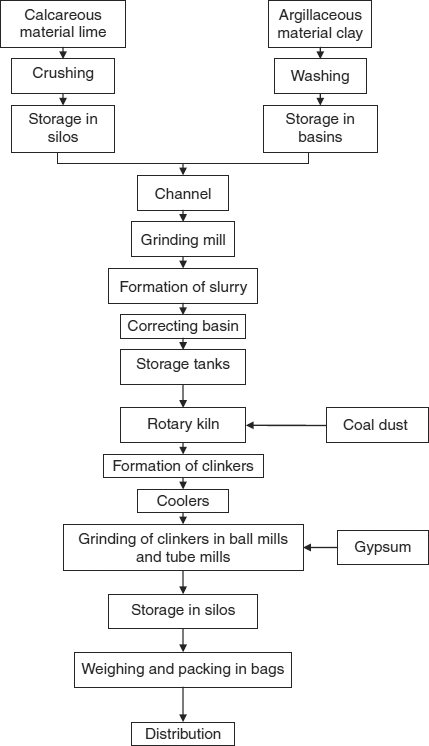
Figure 4.2 Schematic diagram of different processes involved in the manufacturing of cement