Steel can be used for various purposes in building works.
- As structural material in trusses, beams, etc.
- As non-structural material for grills, doors, windows, etc.
- In steel pipes, tanks, etc.
- In sanitary and sewer fittings, rainwater goods, etc.
- Corrugated sheets.
- As reinforcement for concrete.
8.2 STEEL AS A REINFORCEMENT IN CONCRETE
Although plain concrete is very strong in compression, it is very weak in tensile strength. So, steel is being used in concrete as a reinforcement as it is equally strong in compression and tension.
The steel for reinforcing is generally in the form of round bars varying in diameter from 5 to 40 mm, sometimes bars of other forms as mentioned above are also used.
Reinforced Cement Concrete (RCC) is more rigid, highly durable and fire resistant. It possess high tensile strength and it is economical in ultimate cost.
8.3 MARKET FORMS OF STEEL
The following are the various forms in which steel is available in the market:
- Angle sections
- Channel sections
- Corrugated sheets
- Expanded metal
- Flat bars
- I-sections
- Plates
- Ribbed-torsteel bars
- Round bars
- Square bars
- T-section
8.3.1 Angle sections
Angle sections may be of equal legs or unequal legs.
Equal angle sections are available in sizes varying from 20 mm × 20 mm × 3 mm to 200 mm × 200 mm × 25 mm. The corresponding weights per metre length are respectively 0.95 kg and 73.60 kg. Unequal angle sections are available in sizes varying from 30 mm × 20 mm × 3 mm to 200 mm × 150 mm × 18 mm. The corresponding weights per metre length are respectively 1.10 kg and 46.90 kg. Figure 8.1 shows an equal angle section of size 100 mm × 100 mm × 10 mm with weight per metre length as 14.90 kg and an unequal angle section of size 90 mm × 60 mm × 10 mm with weight per metre length as 11.00 kg.
Angle sections are extensively used in structural steel work especially in the construction of steel roof trusses and filler joist floors.
8.3.2 Channel sections
Channel sections consist of a web with two equal flanges.
A channel section is designated by the height of the web and width of the flange. These sections are available in sizes varying from 100 mm × 45 mm to 400 mm × 100 mm. The corresponding weights per metre length are respectively 5.80 kg and 49.40 kg. Figure 8.2 shows a channel section of size 300 mm × 100 mm with weight per metre length as 33.10 kg. The ISI has classified channel sections as junior channel, light channel and medium channel and accordingly they are designated as ISJC, ISLC and ISMC, respectively. Channel sections are widely used as structural members in steel-framed structures.
8.3.3 Corrugated sheets
These are formed by passing steel sheets through grooves. These grooves bend and press steel sheets and corrugations are formed on the sheets. These corrugated sheets are usually galvanized and they are referred to as galvanized iron sheets or GI sheets. These sheets are widely used for roof covering (Figure 8.3).
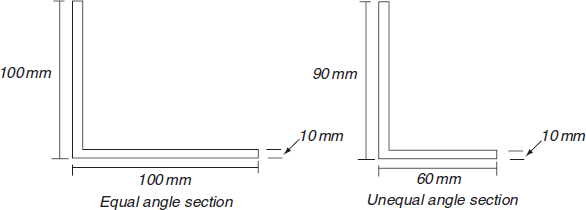
Figure 8.1 Equal angle and unequal angle sections
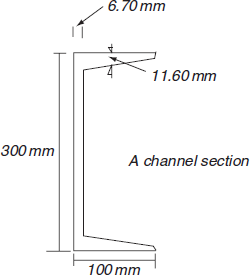
Figure 8.2 A channel section
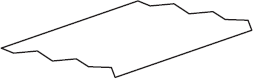
Figure 8.3 Corrugated sheets
8.3.4 Expanded metal
This form of steel is available in different shapes and sizes. It is prepared from sheets of mild steel, which are machine cut and drawn out or expanded. Expanded metal is widely used for reinforcing concrete in foundations, roads, floors, bridges, etc. It is also used as lathing material and for partitions (Figure 8.4).
8.3.5 Flat bars
These are available in suitable widths varying from 10 mm to 400 mm with thickness varying from 3 mm to 40 mm. They are widely used in the construction of steel grillwork for windows and gates.
8.3.6 I-sections
These are popularly known as rolled steel joists or beams. They consist of two flanges connected by a web.
I-sections are designated by the overall depth, width of the flange area and weight per metre length. They are available in various sizes varying from 75 mm × 50 mm at 6.10 kg to 600 mm × 210 mm at 99.50 kg. Figure 8.5 shows a joist of size 300 mm × 150 mm at 37.70 kg. Wide flange beams are also available in sizes varying from 150 mm × 100 mm at 17.00 kg to 600 mm × 250 mm at 145.10 kg. Beams suitable for columns are available in H-sections which vary in sizes from 150 mm × 150 mm at 27.10 kg to 450 mm × 250 mm at 92.50 kg. The ISI has classified the I-sections into junior beams, light beams, medium beams, wide flange beams and heavy beams, and they are accordingly designated as ISJB, ISLB, ISMB, ISWB and ISHB respectively.
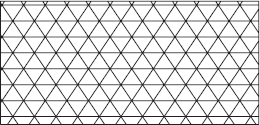
Figure 8.4 Expanded metal
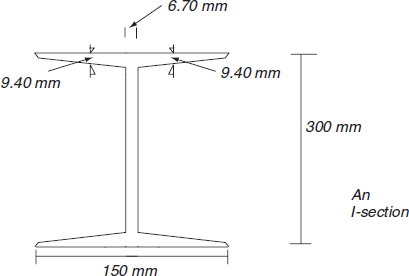
Figure 8.5 An I-section
8.3.7 Plates
The plate sections of steel are available in different sizes with thickness varying from 5 to 50 mm. The corresponding weights per square metre are 39.20 kg and 392.50 kg, respectively. They are used mainly for the following purposes in structural steel work.
- To connect steel beams for extension of the length.
- To serve as tension members of steel roof truss.
- To form built-up sections of steel.
8.3.8 Ribbed-torsteel bars
These bars are produced from ribbed-torsteel which is a deformed high-strength steel. These bars have ribs or projections on their surface and they are produced by controlled cold twisting or hot-rolled bars. Each bar is to be twisted individually and it is tested to conform to the standard requirements. Ribbed-torsteel bars are available in sizes varying from 6 to 50 mm diameter, with the corresponding weight per metre length as 0.222 kg and 15.41 kg. These bars are widely used as reinforcement in concrete structures, such as buildings, bridges, docks and harbour structures, roads, irrigation works, pile foundations and pre-cast concrete structures. The following are the advantages of ribbed-torsteel bars (Figure 8.6).
- It is possible to bend these bars through 180 degrees without formation of any cracks or fractures on their outer surface.
- It is possible to weld certain types of ribbed-torsteel bars by electric flash butt-welding or arc welding.
- There is an overall reduction in reinforcement cost to the extent of about 30–40 per cent when these bars are used.
- These bars are easily identified as they have got a peculiar shape.
- These bars possess better structural properties than ordinary plain round bars. It is, therefore, possible to design them with higher stresses.
- These bars possess excellent bonding properties and, hence, end hooks are not required.
- They can be used for all major types of reinforced concrete structures.
- They serve as efficient and economical concrete reinforcement.
- When these bars are used, the processes of bending, fixing and handling are simplified to a great extent. It results in less labour charges.
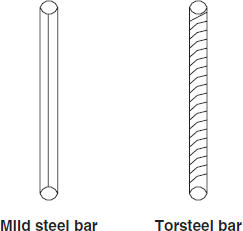
Figure 8.6 Steel bars
8.3.9 Round bars
These are available in circular cross sections with the diameter varying from 5 to 250 mm. They are widely used as reinforcement in concrete structures, construction of steel grillwork, etc. The commonly used cross sections have diameters varying from 5 to 25 mm with the corresponding weights per metre length as 0.15 kg and 3.80 kg, respectively.
8.3.10 Square bars
These are available in square cross sections with sides varying from 5 to 250 mm. They are widely used in all construction of steel grillwork, for windows, gates, etc. The commonly used cross sections have varying sides from 5 to 25 mm with corresponding weights per metre length as 0.20 kg and 4.90 kg, respectively.
8.3.11 T-section
The shape of this section is like that of letter ‘T’ and it consists of a flange and web. Overall dimensions and thickness designate it. These sections are available in sizes varying from 20 mm × 20 mm × 3 mm to 150 mm × 150 mm × 10 mm. The corresponding weights per metre length are 0.90 kg and 22.80 kg, respectively. These sections are widely used as members of steel roof trusses and to form built-up sections.
In addition to the above standard shapes, rolled steel sections are also available in miscellaneous sections such as acute and obtuse angle sections, rail sections, tough sections and z-section. These miscellaneous sections are used to a limited extent in the structural steel work.