According to the proposal made by Watson and Crick for DNA duplication, once DNA replication is initiated, both the old strands of the duplex serve as templates that direct the synthesis of new complementary strand. Thus, each daughter DNA retains half of the parental DNA, i.e., the replication is semi-conservative.
Figure 3.3 Semi-conservative replication-Messelson and Stahl experiment (a) Bacteria grown in 15N and 14N medium (b) Semi conservative replication
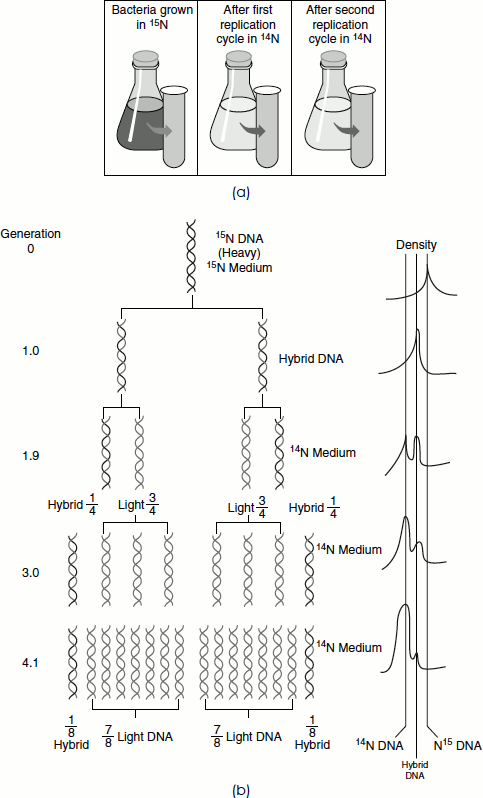
In 1958, Matthew Meselson and Franklin Stahl of California Institute of Technology confirmed the semi-conservative nature of DNA replication in bacteria using radioisotopes through a series of experiments. They grew E. coli cells for many generations in media containing 15N-ammonium chloride as the sole source of nitrogen. As the result, the nitrogen bases of the DNA of these bacterial cultures contained only the heavy nitrogen isotope. The cells were then transferred to a new medium containing the normal lighter isotope of nitrogen 14N. At various time after the transfer, bacterial cells were collected. The DNA was then extracted from the bacterial cells. The extracted DNA was loaded on a caesium chloride density gradient and subjected to equilibrium density gradient centrifugation. The DNA molecules moved on the gradient until their density matched with that of the gradient. The DNA bands were visualized under UV light and photographed. DNA containing 14N sank to a position determined by its density. DNA containing 15N is denser than 14N hence sank to a lower position in caesium chloride. After one generation in 14N medium, the bacteria yielded a single band of DNA with the density between that of 14N and 15N DNA, indicating that only one strand of the duplex contained 15N (Figure 3.3).
After two generations in 14N medium, two bands were obtained, one of intermediate density (in which one strand contained 15N) and one band of low density (in which neither strand contained 15N). Meselson and Stahl concluded that DNA replication involves building new molecules by separating parental strands and then adding new nucleotides to form the complementary strands on these templates.