DNA and RNA at a glance look similar; however, RNA differs from DNA in many ways, i.e., it has uracil instead of thymine; ribose sugar instead of deoxyribose; single-stranded and has the potential for structural diversity than the DNA. Thus, RNA is suited to a variety of cellular functions. RNA is the only macromolecule that has a role in the storage, transmission and catalysis.
Figure 4.1 Central dogma of molecular biology
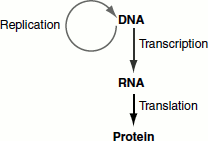
In 1958, Francis Crick proposed the relationship among DNA, RNA and protein by what he called as the ‘Central Dogma of Molecular Biology’ (Figure 4.1). DNA directs its own replication and its transcription to RNA, which, in turn, directs its translation to proteins. In eukaryotes, most of the cell’s DNA is confined to the nucleus; in addition, during transcription, there is a flow of genetic information from nucleus to cytoplasm where protein synthesis takes place.
The synthesis of RNA under the direction from a DNA template catalysed by the enzyme RNA polymerase (transcriptase) in a reaction that utilizes nucleotide triphosphates as substrates and frees pyrophosphates with the formation of internucleotide bonds is called transcription. The DNA strand that directs the synthesis of RNA is called the ‘template strand’ also called the ‘antisense strand’, ‘nonsense strand’ or ‘minus (−) strand’ (Figure 4.2).
Transcription produces an RNA chain that is identical in sequence with one strand of the DNA, which is called ‘coding strand‘; this strand is made in the 5′ → 3′ direction and is complementary to the template strand. This strand of DNA is also called ‘the sense strand’ or ‘plus (+) strand’. The transcription results in the formation of an RNA transcript initially, which is the same as the sense strand of DNA, except that the nucleotides of RNA have ribose sugar instead of deoxyribose sugar and the base uracil is replaced for the thymine.
RNA synthesis is catalysed by the enzyme RNA polymerase. Transcription starts when an RNA polymerase binds to a special region called the promoter, at the start of the gene. The promoter includes the first base pair (bp) that is transcribed into RNA (the start point) as well as surrounding bases. From this position, the RNA polymerase moves along the template, synthesizing the RNA until it reaches a terminator sequence, where transcription ends. Thus, a ‘transcription unit’ extends from the promoter to the terminator. A transcription unit constitutes a stretch of DNA used as a template for the production of a single molecule of RNA.
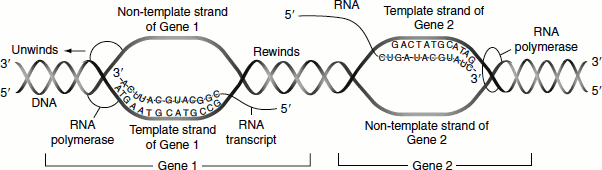
Since genes are present on both the strands, same strand of DNA may become antisense strand for one gene and sense strand for another gene. See Genel and Gene 2 carefully in the following Figure 4.3 that the template strand in two genes are not the same.
With respect to the start point of transcription, two sequences can be described; namely, upstream and downstream sequences. The ‘upstream sequences’ are the sequences before the start point of transcription, while the ‘downstream sequences’ are those after the start point. The DNA sequence of the non-template strand, which has the same sequence as the RNA, is only usually referred to describe the base positions. Base positions are numbered in both directions of the start point. The start point of transcription is assigned +1; the numbers increase, as they go downstream. The base before the start point is numbered as −1 and the negative numbers increase going upstream. (There is no base assigned the number zero.)
Figure 4.2 Flow of genetic information from DNA to proteins
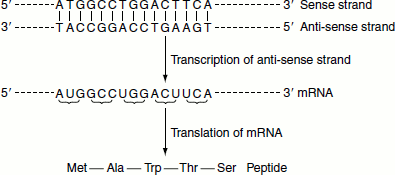
Figure 4.3 Template and non template strands of genes are not the same
The first stage in gene expression is transcription and, therefore, it is regulated most often. The transcription by RNA polymerase is often determined by the binding of regulatory factors, which modulate gene expression.