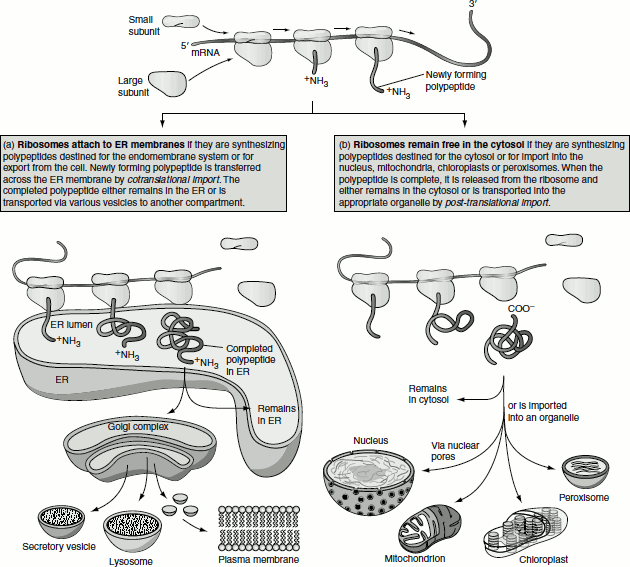
There are 10,000 different kinds of proteins in a mammalian cell. Most of these proteins are synthesized by cytosolic ribosomes and they remain within the cytosol. However, many of the proteins produced in a cell are delivered either to a particular cell membrane or to the cell surface for secretion. For example, many hormone receptor proteins and transporter proteins must be delivered to the plasma membrane and some water-soluble enzymes such as RNA and DNA polymerases and histones must be targeted to the nucleus. All the proteins produced by a cell must reach their correct locations for the cell to function properly. The delivery of newly synthesized proteins from the cytosol to their proper cellular locations is referred to as ‘protein sorting, protein targeting or protein trafficking’.
There are two basic forms of targeting pathways (Figure 6.1):
- Post-translational targeting: It occurs soon after the synthesis of protein by translation at the ribosome. These proteins are targeted to
- nucleus,
- mitochondria,
- chloroplasts and
- peroxisomes.
- Co-translational targeting (secretory pathway): Proteins as they are translated are targeted to the endoplasmic reticulum (ER) and thereby enter the secretory pathway. These proteins are targeted to
- ER,
- Golgi apparatus,
- lysosomes,
- plasma membrane and
- secreted proteins.
Figure 6.1 Post translational and co-translational protein targeting