Francis Jacob and Jacques Monod described the operon model in 1961, based on the regulation of lactose metabolism by the intestinal bacterium E. coli. Lactose operon is an ‘inducible operon’, because lactose induces the transcription of the operon. The lac operon is normally off, but when a molecule called an ‘inducer’ is present, the operon turns on. The lac operon consists of one regulatory gene (the i gene) and three structural genes (z, y and a). The i gene codes for the repressor of the lac operon.
The lactose operon

The repressor
The repressor is a tetramer of identical subunits of 38 kD each. A wild-type E. coli cell contains approximately 10 tetramers. The repressor gene is an unregulated gene. It is transcribed into a monocistronic mRNA. The repressor functions by binding to an operator.
The operator
The operator lies between the promoter and the structural genes. The sequence of the operator includes an inverted repeat. When the repressor binds to the operator, it prevents RNA polymerase from initiating transcription at the promoter. The operator extends from −5 upstream to +21 within the transcription unit. Thus, it overlaps the 3′ right end of the promoter. Operator mutation results in the constitutive expression of the lac operon.
The structural genes
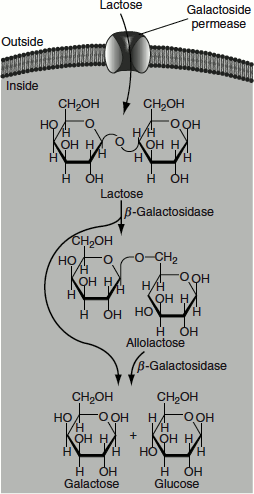
The Z gene codes for β-galactosidase, which is primarily responsible for the hydrolysis of the disaccharide, lactose into its monomeric units, galactose and glucose (Figure 7.2). The Y gene codes for permease, which increases the permeability of the cell to β-galactosides. The A gene codes for transacetylase, which participates in detoxification. During normal growth on a glucose-based medium, the lac repressor is bound to the operator region of the lac operon, preventing transcription.
The lac mRNA is extremely unstable and decays with a half-life of only approximately three minutes. This allows induction to be reversed rapidly by repressing transcription as soon as the inducer is removed.
Figure 7.2 Action of β-galactosidase