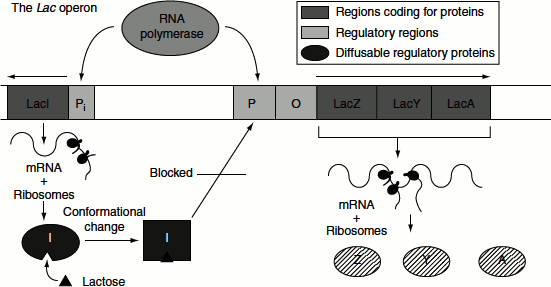
When lactose is present in the medium, small amounts of lactose enters inside the bacterial cell via the basal level of permease expression and is hydrolysed to the lactose isomer called allolactose, which acts as an inducer. Allolactose binds to the repressor protein in the inducer-binding site. This binding causes conformational change in the repressor protein and consequently repressor loses its hold on the operator site. RNA polymerase binds to the promoter sequences and initiates the transcription of the structural genes. The mRNA is translated to produce the lac operon enzymes, which permits the entry of more lactose into the cell and converts it into glucose and galactose. Thus, in the presence of an inducer, the lac operon is in a de-repressed state (Figure 7.5).
Positive Regulation by cAMP
If the concentrations of glucose is low and lactose is high, the concentration of cAMP will be high, CRP also called CAP will be activated and bind to the DNA, which will promote RNA polymerase binding and initiate transcription.
CRP is a dimer of two identical subunits of 22.5 kD, which can be activated by a single molecule of cAMP. A CRP monomer contains a DNA-binding domain and a transcription-activation domain. A CRP dimer binds to a site of approximately 22 base pairs (bp) at the promoter region. CRP induces large bend when it binds DNA. This possibly allows CRP to contact RNA polymerase at the promoter and allows positive regulation.
Figure 7.5 Positive regulation of Lac operon
Gratuitous Inducers
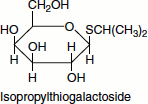
Lactose is rarely used in experiments to study the expression of lac genes, because the β-galactosidase produced will act on lactose and reduce the level of lactose that may complicate the analysis of the lac operon. For this purpose, two sulphur-containing analogues of lactose, namely isopropylthiogaloside (IPTG) and thiomethyl galactoside are used, which are effective inducers without being the substrate for β-galactosidase. These are called ‘gratuitous inducers’. That is these are substances that resemble natural inducers but cannot be metabolized by the enzymes.