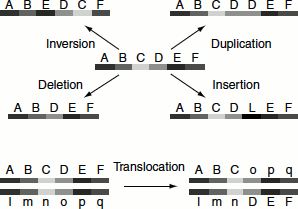
Mutagens can even affect the chromosomes. The chromosomal changes can be either involving their structure or their number. The numerical changes are referred to as ‘ploidy’. It can be detected as ‘aneupoidy’ and ‘polyploidy’. The structural abnormalities include ‘deletions’, ‘duplications’, ‘inversions’, and ‘translocations’. These changes in the structure and the number of the chromosome are referred to as ‘chromosomal aberrations’ (Figure 8.8).
Figure 8.8 Chromosomal aberrations
Some mutagens directly alter specific chromosomal proteins (DNA topoisomerase II and peripheral proteins) to produce chromosome stickiness, which causes chromosome aberrations.
Amplifications or gene duplications: They lead to the multiplication of chromosomal regions, increasing the genes located within them.
Deletions: The loss of large chromosomal regions resulting in the loss of the genes located within those regions.
Translocations: They lead to the interchange of chromosomal segments between non-homologous chromosomes.
Inversions: They reverse the orientation of the genetic segments.
Chromosomal Numerical Changes
‘Aneuploidy’ is an abnormality in the number of chromosomes. An extra or missing chromosome is basically the defect. This is because of the unequal separation of chromosomes during cell division (Table 8.1).
Table 8.1 Ploidy
Number of chromosomes
Name of the aberration
Description
1
Monosomy
This refers to the lack of one chromosome of the normal complement. Partial monosomy can occur in unbalanced translocations or deletions, in which only a portion of the chromosome is present in a single copy. Turner syndrome is caused because of monosomy of the sex chromosome (45, X).
2
Disomy
Disomy is the presence of two copies of a chromosome. For organisms such as humans that have two copies of each chromosome (those that are diploid), it is the normal condition. For organisms that normally have three or more copies of each chromosome (those that are triploid or above), disomy is an aneuploid chromosome complement. In uniparental disomy, both copies of a chromosome come from the same parent (with no contribution from the other parent).
3
Trisomy (2n+1)
Trisomy refers to the presence of three copies, instead of the normal two, of a particular chromosome. The presence of an extra chromosome 21, which is found in Down syndrome, is called trisomy 21. Trisomy 18 and Trisomy 13, known as Edwards and Patau Syndrome, respectively, are the two other autosomal trisomies recognized in humans. Trisomy of the sex chromosomes is possible, such as in (47, XXX), (47, XXY) and (47, XYY).
4/5
tetrasomy/pentasomy (2n+2) or (2n+3)
Tetrasomy and pentasomy are the presence of four or five copies of a chromosome, respectively. Although rarely seen with autosomes, sex chromosome tetrasomy and pentasomy have been reported in humans, including XXXX, XXXXX, XXXXY and XYYYY.
Polyploidy
Polyploidy refers to a numerical change in a whole set of chromosomes and is used to describe cells and organisms containing more than two paired (homologous) sets of chromosomes.