rDNA technology has gained importance in each and every aspect of modern biological researches. The rDNAs are used in basic research or in the commercial production of useful products. rDNA also find application in agriculture and industry.
In Pharmaceutical Industry
Important compounds such as recombinant insulin, which are used in the treatment of diabetes, human growth hormone (hGH)/somatotropine and interferons can be produced by rDNA technology.
Synthesis of recombinant insulin
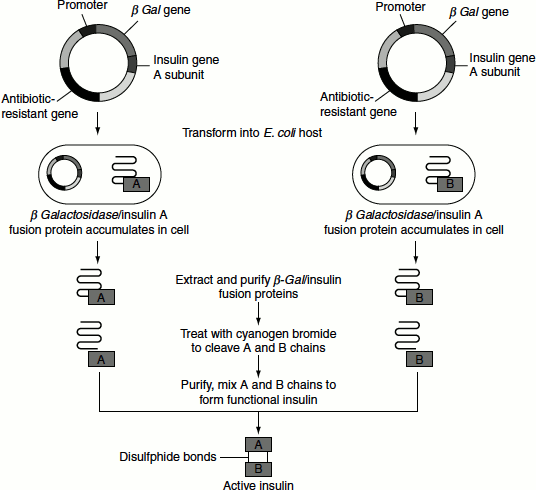
Mature insulin has A-chain of 21 amino acids and B-chain of 30 amino acids held together disulphide bridges. It is secreted by the pancreatic β-cells. The DNA with the correct nucleotide sequences to specify the A- and B-polypeptide chains are chemically synthesized. About 63 nucleotides encode the A-chain (21 × 3 = 63) and 90 nucleotides encode the B-chain (30 × 3 = 90). A stop codon and an initiating AUG codon, along with the respective genes for A- and B-chains, were ligated into the lacZ’ gene of E. coli, which was carried in a plasmid expression vector.
The codons must be placed in correct reading frame with that of the lacZ’ gene. The recombinant plasmids were then introduced into E. coli. The recombinant plasmid vector carrying the gene of interest autonomously replicates and is transcribed and translated in the bacterial host. The protein so produced is called a ‘fusion protein’, as it contains a part of β-galactosidase fused by methionine residue to either A-chain or B-chain.
Methionine does not occur in either A-chain or B-chain. Therefore, by treatment with cyno-gen bromide, a chemical that destroys methionine, the A- and B-chains can be released from the β-galactosidase fragment. The A- and B-proteins are then purified, mixed and disulfide bridges were formed to give pure human insulin (Figure 9.31).
Synthesis of somatotropin
Somatotropin, the hGH, is secreted by the anterior lobe of pituitary and consists of 191 amino acid units. The deficiency of somatotropin has been estimated to about 1 in 5,000 children. Hence, there is a need to synthesize this hormone commercially for pharmaceutical purpose. Double-stranded cDNA, produced from mRNA precursor of hGH, was ligated to suitable vector and incorporated into bacterial cell. The synthesis of hGH is induced by an inducer of lac operon (IPTG). The hGH produced is subsequently purified. About 100,000 molecules of the hormone per cell of E. coli can be produced.
Synthesis of interferon
Interferons are proteins that exert non-specific antiviral activity. Interferon is used to cure many viral diseases such as common cold and hepatitis. There are three main classes of interferons, namely IFN-α or leucocyte interferon, IFN-β or fibroblast interferon and IFN-γ or immune interferon. The cDNA prepared from leucocytes, fibroblast and immune cells can be ligated to suitable expression vector and can be cloned in E. coli.
Figure 9.31 Production of recombinant insulin
Synthesis of vaccines
Recombinant vaccines for hepatitis B virus (HBV) are produced by cloning HBsAg gene of the virus in yeast cells. The HBsAg gene is introduced near the yeast alcohol dehydrogenase I promoter. The HBsAg gene contains 6-bp-long sequence preceding the AUG that synthesizes the N -terminal methionine. This is joined to ADH promoter and cloned in the yeast vector PMA-56. The recombinant plasmid is inserted into yeast cells. The transformed yeast cells are multiplied in tryptophan-free medium. The transformed cells are selected and cultured. The expressed HBsAg protein has similar structure and immunogenicity that of the HBV and elicits an immune response thus acting as a vaccines.
Gene Therapy
This is the process of treatment by which defective genes are replaced with normal ones. It is of two types, namely gene replacement therapy and gene augmentation therapy. Gene therapy requires:
- Isolation of particular gene together with its regulatory sequence.
- Sufficient number of cells from the patient into which the gene is to be inserted.
- An effective way of returning these cells to the patient.
There are two main strategies of gene therapy namely:
- Somatic gene therapy : Correcting a genetic defect in the somatic cell of the body.
- Germ line gene therapy : Introduction of genes into the germ cells for correction of the genetic defect in the offspring.
Gene delivery strategies:
- Viral : Replication defective retroviral safe vector is tranfected into a packaging cell line. This packages the recombinant safe vector carrying the foreign DNA, with the help of gag, pol and env proteins. This is then allowed to infect the target cell. Within the target cell, it is integrated randomly into host DNA and the foreign gene is expressed.
- Non-viral : This includes various methods such as aerosol delivery of genes to lungs, direct DNA injection into skeletal muscle and gene-coated gold particles bombardment into liver cells.
Construction of Industrially Important Bacteria
Bacteria with novel phenotypes can be produced by rDNA technology. For example, several genes from different bacteria have been inserted into single plasmid that has been introduced in marine bacterium, making it capable of metabolizing petroleum. This organism has been used to clean up oil spills in oceans. Furthermore, many bacteria are designed to synthesize industrially important chemicals. Some bacteria are also designed to compost waste more efficiently and to fix nitrogen. An interesting example is a strain of Peudomonas fluoresecens that lives in association with the roots of maize and soya bean. A lethal gene from Bacillus thuringiensis, a pathogenic bacterium to the black cutworm has been engineered into this bacterium. Inoculation of soil with engineered P. fluorescens resulted in the death of black cutworm.
Genetic engineering of plants
Altering the genotypes of plants is an important application of rDNA technology. With the help of Ti plasmids, it is possible to introduce genes from one plant into another, thus introducing desired char-acters in required plants. In this way, crop improvements can be made.
Transgenic farm animals
rDNA technology is helpful for the production of transgenic animals. For example, caseins are the major milk proteins. By transferring genetically manipulated casein genes, the texture of cheese and heat-stable dairy products can be improved.
For clearing environmental pollution
Genes responsible for degradation of environmental pollutants such as toluene, chlorobenzene, halo-genated pesticides and other toxic compounds have been identified.
For example, OCT plasmid degrades octane, hexane and decane and XYL plasmid degrades xylene and toluenes.