Blotting techniques are important tools both in molecular biology and in clinical research. These techniques are used to identify proteins and nucleic acids. The blotting techniques generally involve fours steps, namely:
- Electrophoretic separation of proteins or nucleic acids,
- Transfer to nitrocellulose membrane,
- Binding of probe to the target molecule and
- Visualization of the bound probe.
There are three main types of blotting techniques, namely:
- Southern blotting,
- Northern blotting and
- Western blotting.
Southern Blotting
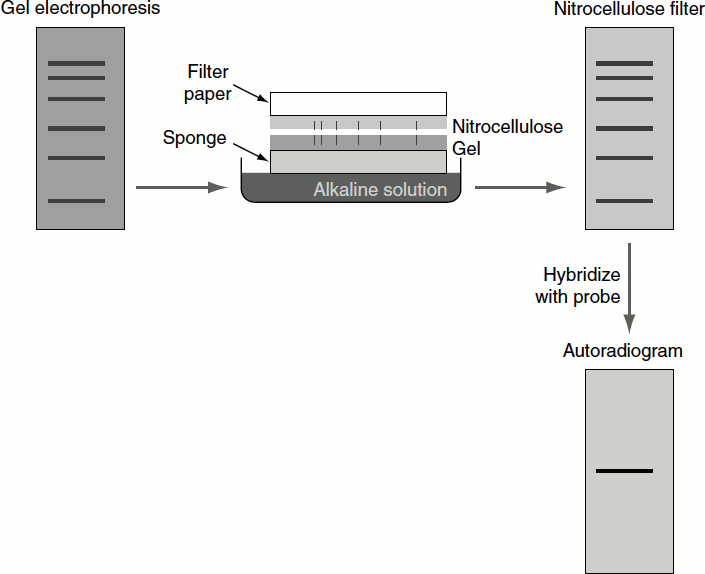
This is a DNA-DNA hybridization technique. It is often used to identify the position of a single gene on a chromosomal DNA. The procedure involved for carrying out Southern blotting is as follows:
- First, the chromosomal DNA is fragmented by treatment with restriction endonucleases.
- After enzymatic digestion, the DNA fragments are subjected to electrophoresis in agarose. The DNA fragments are separated according to their size.
- The electrophoresis gel is then covered with a sheet of nitrocellulose paper. The DNA gets adsorbed onto the nitrocellulose paper.
- Before hybridization, the blotted DNA is treated with mild alkaline solution, so that the DNA fragments become single stranded.
- The nitrocellulose sheet is then incubated with the DNA probe, which is usually radio-labelled cloned DNA. The DNA probe complementarily hybridizes with the DNA fragments.
- The nitrocellulose sheet is then covered with a photographic film or an X-ray film and this helps in the localization of the gene under examination (Figure 12.7).
Figure 12.7 Southern blotting
Northern Blotting
This is basically a technique for the identification of RNA. The procedure involved here is same as Southern blotting excepting that complementary DNA is used to probe RNA. Messenger RNA (mRNA) is first separated by electrophoresis. This is followed by transfer to nitrocellulose paper and hybridization with the probe. This method helps to measure and study the transcription of specific genes (Figure 12.8).
Western Blotting
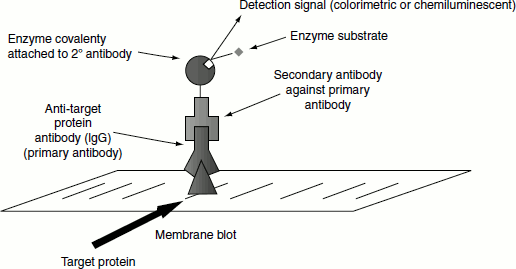
This is a method for the identification of proteins. This method requires the use of specific antibodies to the protein of interest. The antibodies can be serum sample (infected patients serum), polyclonal or monoclonal preparations. The various steps involved can be described as follows (Figure 12.9):
- The protein is first electrophoresed in PAGE and resolved into its components.
- The electrophoresis gel is then covered with a sheet of nitrocellulose paper and the proteins are transferred to the nitrocellulose paper.
- The nitrocellulose paper is then treated with the primary antibody which binds to the protein of
- This is followed by the binding of the enzyme-labelled secondary antibody, which binds to the primary antibody.
- The chromogenic enzyme substrate is then added.
- The substrate upon enzyme action gives colour and thus allows visualizing and locating the protein of interest.
Figure 12.8 Northern blotting
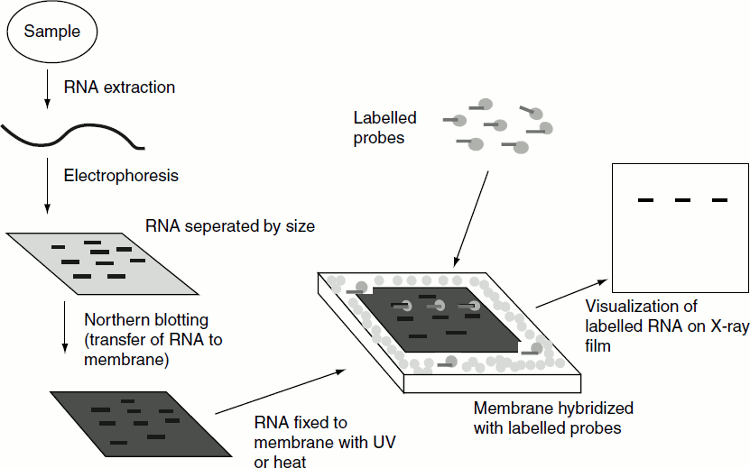
Figure 12.9 Western blotting