Nouns and pronouns may change case depending on the role they play in a sentence. English has three cases:
Subjective: The noun or pronoun serves as the subject of the sentence—the person, place, or thing doing the action or existing in some state or quality of being.
Objective: The noun or pronoun is on the receiving end of the action, typically as a direct object (the object being acted upon) or the indirect object (the object receiving the direct object). For example, if I pay you $25, the $25 is the direct object, because that’s what I’m handing you, and you’re the indirect object, because you’re receiving the money.
Possessive: Nouns and pronouns in the possessive case own something. To show ownership, you add –’s to the end of a noun or just an apostrophe to plural nouns ending in –s. Pronouns show ownership much differently, as explained next.
DEFINITION
Case is the form of a pronoun that reflects how the pronoun functions in a sentence.
When nouns change case, you barely notice because all they do is tack on –’s to form the possessive. When pronouns change case, they morph into entirely different beings. Here’s just a small sample for comparison purposes:
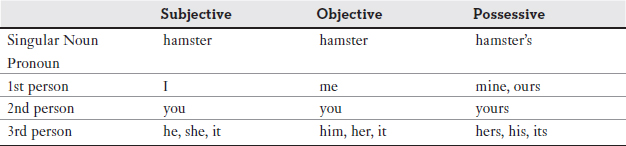
To find out more about how pronouns change case, check out the earlier section that focuses solely on pronouns.