Copying of a DNA template strand into a complementary strand is a common feature of DNA replication. The polymerization of the new DNA strand is brought about by an enzyme called DNA polymerase. The building blocks added to a growing daughter strand are individual nucleotides. The substrates for DNA syn thesis are 2′-deoxyribonucleotides.
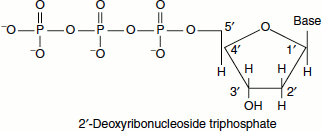
The addition of the nucleotides occurs via a nuclephilic attack. The 3′-OH at the growing DNA chain attacks the alpha phosphate group of an incoming nucleotide. This results in the formation of the phosphodiester bond between the growing daughter strand and the next nucleotide. The 3′-OH of the newly added nucleotide is now exposed on the end of the growing chain and can attack the next nucleotide in the same way (Figure 3.1).
Figure 3.1 Addition of nucleotides to a growing daughter strand. Schematic representation of growing polynucleotide chain. The lines represent the ribose sugar with 3′-OH; ‘P’ represents a phosphate group
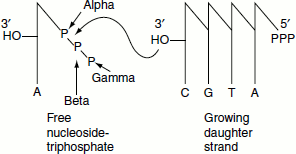
The high-energy bond between the β- and γ-phosphates of the incoming nucleotide breaks and provides the necessary energy for its addition to the nucleic acid chain. The subsequent hydrolysis of the pyrophosphate drives the reaction in the forward direction.