- Inhibitors of DNA replication are used as prime drugs for suppressing proliferative, viral, bacterial and auto-immune diseases. The inhibitors of nucleic acid synthesis have various effects.
- They block the synthesis of nucleotide precursors or their polymerization.
- Some inhibitors are incorporated as nucleotide analogues.
- Other inhibitors interfere with template function by binding, modifying or degrading DNA. Some inhibitors bind and inactivate the replication proteins.
- Physical agents such as UV and X-ray inhibit the DNA replication by damaging the DNA.
- Some inhibitors act indirectly. The inhibitors of mitosis profoundly affect the DNA synthesis by preventing its initiation (Figure 3.15) (Table 3.3).
Inhibitors of Nucleotide Biosynthesis
Reducing the supply of precursors limits the rate of nucleic acid biosynthesis and leads to mutations in DNA template. The inhibitor can function as:
- an antimetabolite that is blocking the enzymatic use of the substrate,
- an alternative substance incorporated into the DNA and
- an analogue of feedback inhibition of the enzyme that is responsible for its biosynthetic regulation.
Inhibitors of Purine Biosynthesis
Azaserine and 6-diazo-5-oxo-L-norleucine (DON)—the analogues of glutamine—inhibit three reactions in purine biosynthesis. Their activities in inhibiting cell division primarily arise from the inhibition of formylglycinamide ribonucleotide amidotransferase. They form covalent bond with the cysteine residue in the active site of the enzyme. They also inhibit cytidine triphosphate synthase.
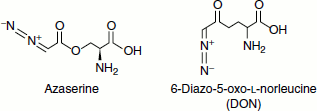
Figure 3.15 Inhibitors of DNA replication
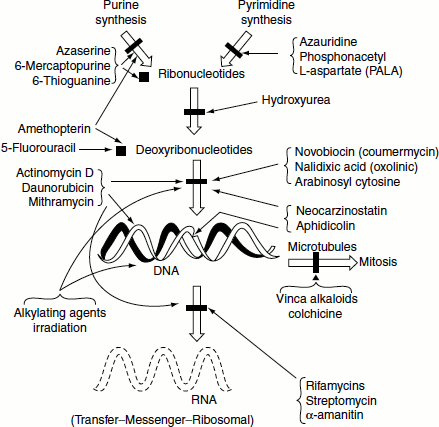
Table 3.3 Inhibitors of DNA replication
| Analogue chain terminators | Incorporated into DNA or RNA | Inhibition |
|---|---|---|
| 2′3′ Dideoxy NTPs | ||
| AZT—azidothymidine | DNA | Chain growth 3′→5′ Exonuclease activity of polymerase. |
| Arabinose NTP | DNA | |
| Acyclovir NTP (analogue of G) | DNA | Chain growth |
| Cordycepin | DNA, RNA | Chain growth |
| Defective nucleic acid | ||
| Uracil dNTP (analogue of T) | DNA | DNA integrity, excision leads to chain breakage |
| 5-Bromouracil | DNA | Fidelity of replication |
| 5-Iodouracil | DNA | Mutation |
| Allopurinol | DNA | Xanthine oxidase |
| 5-Azacytidine | DNA | Chain growth |
| Thioguanine | DNA | Fidelity of DNA replication |
6-Diazo-5-oxo-L-norleucine (DON)DON is a cytotoxic inhibitor of many enzymes of nucleotide synthesis. DON treatment leads to apoptosis, the programmed cell death.
Analogues of Purine and Pyrimidine Bases
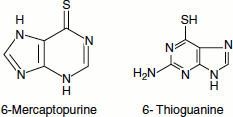
A few examples of the analogues of purine and pyrimidine bases are 6-mercaptopurine and 6-thioguanine.
6-Mercaptopurine, brand name Purinethol, is an immunosuppressive drug, which is used in the treatment of leukaemia. It interferes with nucleotide interconversion and glycol protein synthesis.
6-Thioguanine is also used in the treatment of cancer. It is guanine analogue. After incorporation into DNA, the thiocarbonyl group of thioguanine has the tendency to be methylated. This produces a base similar to 6-o-methylguanine. During second round of replication, the mismatch repair system will recognize the mismatch between the methylated base and cytosine. This results in persistent single-strand breaks in the DNA. The genotoxic stress triggers cell death.
Inhibitors of Folate Synthesis
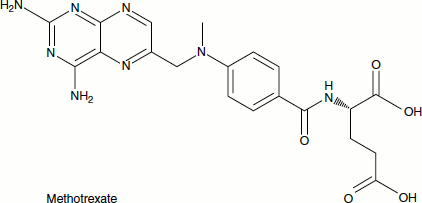
The conversion of folate to tetrahydrofolate is required for its coenzymic function in all cells. The inhibition of dihydrofolate reductase (DHFR) depletes the coenzyme thereby blocking the synthesis of purine nucleotides; for example, trimethoprin for bacterial enzyme and methotrexate/aminopterin for animal cell enzymes. Sulpha drugs also block the microbial biosynthesis of folate. Folate analogues such as Lecoverin (5-formyl-tetrahydrofolate) can also inhibit the action of DHFR.
Inhibitors of Deoxynucleotide Synthesis
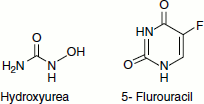
Hydroxyl urea destroys free radicals of E. coli ribonucleotide reductase and is a potent reversible inhibitor of the mammalian reductase. Its action blocks the production of all deoxyribonucleotides and hence blocks the DNA replication. 5-Flurouracil in the form of deoxynucleotide covalently binds and inactivates thymidylate synthase and inhibits the biosynthesis of thymidylate.
Catabolite Analogs
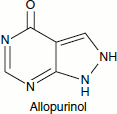
Anti-tumour activity of allopurinol, the structural analogue of hypoxanthine, Nis due the inhibition of xanthine oxidase enzyme. Adenosine analogues inhibitadenosine deaminase and also inhibit replication.
Inhibitors that Modify DNA
Although DNA is relatively unreactive chemically, the need to preserve its conformation and continuity makes it vulnerable to agents that bind it covalently or non-covalently. For example, acridine, ethidium and propidium dyes. The intercalation of these agents into the DNA does not allow strand separation and hence inhibits replication. Mitomycin and porfiromycin inhibit DNA synthesis by interstrand cross-linking of DNA. Aureomycin introduces single-strand breaks in linear duplex, a superhelical DNA by damaging the deoxyribose to release free base. cis -Diamminedichloridoplatinum (II) (CDDP) is a platinum-based chemotherapy drug used to treat various types of cancers, including sarcomas, some carcinomas (e.g., small cell lung cancer and ovarian cancer), lymphomas and germ cell tumours. It was the first member of its class, which now also includes carboplatin and oxaliplatin. Platinum complexes are formed in cells, which bind and cause cross-linking of DNA ultimately triggering apoptosis, or programmed cell death.
Inhibitors that Affects Enzyme of Replication
- Acridines, anthracyclins, ellipticines and epipodophyllotoxins inhibit all four categories of eukaryotic type II topoisomerases. Nalidixic acid and Fluoroquinolones are antibiotics used to inhibit bacterial topoisomerases.
- Aphidicolin inhibits eukaryotic polymerase a and polymerase δ.
- Rifamycin and Rifampicin inhibit RNA polymerase.