Introduction
Mosquitoes are, ironically, the most popular insect vectors of animal diseases across the world. Female mosquitoes are hematophagous, feeding on vertebrate blood for egg production and maturation. Different species of mosquitoes prefer different hosts. During feeding, a female mosquito injects her proboscis and discharges saliva inside the host’s skin, causing an itchy reaction. If this mosquito is carrying disease pathogens from an earlier blood meal, after sufficient pathogen development (incubation) in its body, the pathogen may be transmitted to the new host. The incubation period varies for every pathogen ranging from days to weeks.
Mosquitoes are vectors of human diseases like
- Dengue fever
- Yellow fever
- Arboviral encephalitis
- Zika
- Chikungunya
- Malaria, and
- Filariasis
Mosquitoes cannot survive in moving water bodies. They prefer to live in stagnant pools and seepage water near flowing water streams. The life-cycle, pattern-egg laying, and larval habit depend on the selection of habitat. Based on their habitat preference, mosquitoes can be categorized in standing waters (permanent or transient) and flood water (natural or artificial containers). Species living in standing water lay their eggs singly or in rafts on the surface of the water and can survive for several broods in harsh environmental conditions after mating and blood engorging. But species living in floodwaters, deposit their eggs in a separate location due to periodic flooding of the area, near damp soil, inside tree holes and artificial containers. They produce one to many broods annually and can overwinter their eggs in harsh environments. Mosquitoes are adapted to changing climates and environments, therefore can adjust to multiple habitat types for their growth and survival.
Life Cycle and Developmental Stages
A major part of the life of a mosquito is spread in water, only the adult stage causes harm to human and animal health. The knowledge of every life cycle stage is important to initiate measures of control before maturing into adults. Every mosquito goes through four distinct stages-egg, larva, pupa, and adult to complete its life cycle, but the length of each stage depends on the ambient temperature and food sources.
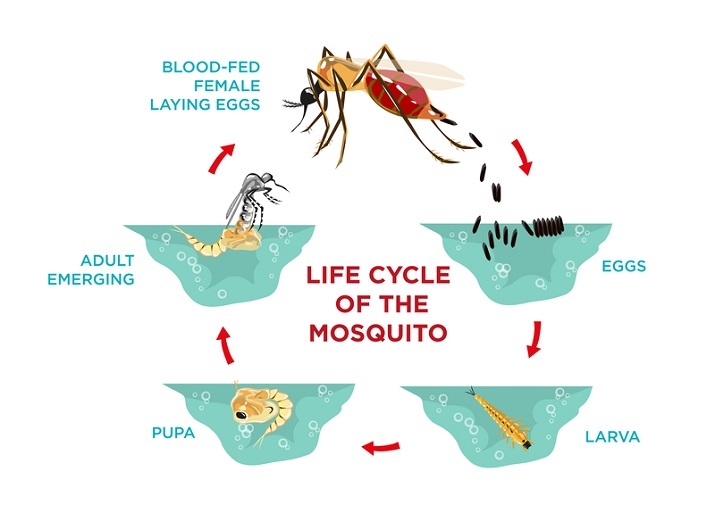
- Egg − Mosquito species can be divided into two categories depending on the location of eggs laid-floodwater mosquito species lay their eggs above the water surface level because of periodic flooding they can survive for three months to two years and standing water mosquito species lay eggs on the surface of standing water bodies like permanent pools, eggs are laid singly or in clutches, each consisting of hundred to two-hundred eggs forming egg rafts. These eggs hatch within twenty-four to forty-eight hours depending on environmental conditions.
- Larva − On hatching from eggs, mosquito larvae are formed which molt through four instars, increasing in size with each molt. Larvae breathe vigorously atmospheric oxygen and lay horizontally or at a forty-five-degree angle to the water surface. Some larvae puncture the underwater plant cells to receive oxygen and never come to the surface.
- Pupa − The fourth instar larva is transformed into a comma-shaped structure after molting called the pupa. This is the transition phase between aquatic stages to the terrestrial stage of a mosquito’s life cycle. Pupas do not feed and undergo tumbling motion to escape predation. Pupa molts and within twenty-four to forty-eight hours, the pupa will molt into an adult.
- Adult − After emergence adult mosquitoes seek a protective environment and hide in the surrounding vegetation to complete the development of their wings. Males emerge before females and mate with the female as soon as she is capable. Both require carbohydrate sources for nourishment which are derived from the nectar of flowers and plant juices to maintain energy for flying, mating, and finding hosts for blood meals. Only female mosquitoes require bloodmeal to get extra protein for egg development. Intake of bloodmeal is the way mosquitoes acquire viruses, protozoans, and helminths and transmit them to humans and other animals. Male mosquitoes can live only for one or two weeks, while females may survive up to producing multiple batches of eggs. Some species of mosquito can overwinter after consuming bloodmeal and live for several months
The life cycle of three important mosquitoes – Aedes, Anopheles, and Culex are studied, they show different morphological differences in their developmental stages which are a useful source of information in vector control and elimination programmes.
Explore our latest online courses and learn new skills at your own pace. Enroll and become a certified expert to boost your career.
Comparison between Aedes, Anopheles, and Culex mosquitoes
| Character | Aedes | Anopheles | Culex |
|---|---|---|---|
| Disease | Dengue fever, yellow fever, Chikungunya, and Zika | Malaria | West Nile fever, Japanese encephalitis, and Filariasis |
| Activity | Active and aggressive in the daytime | Mostly active at dawn and dusk, but can be active at night | Mostly active at dawn and dusk, but can be active at night |
| Egg shape and egg laying | Spindle shape; freshwater | Boat shape; freshwater | Cigar shape; polluted water |
| Larvae | Floats obliquely to the water surface | Floats horizontally to the water surface | Floats obliquely to the water surface |
| Pupa | Colourless | Green | Colourless |
| Adult | Narrow black body, patterns of light and dark scales on abdomen and thorax, light and dark bands on legs. | Black or brown in colour, a pair of maxillary palps same in length as proboscis. | Whitish or greenish in colour, short and dark maxillary palps and a long dark proboscis, dark abdomen reflecting bronze or blue-green scales. |
| Wings | Dark and white bands. | No bands. | bands |
| Adult resting position | Sits parallel to the surface. | Sits at 450 angles to the surface. | Sits parallel to the surface. |
| Sound | Makes little sound. | Make a peculiar sound. | Makes no sound. |