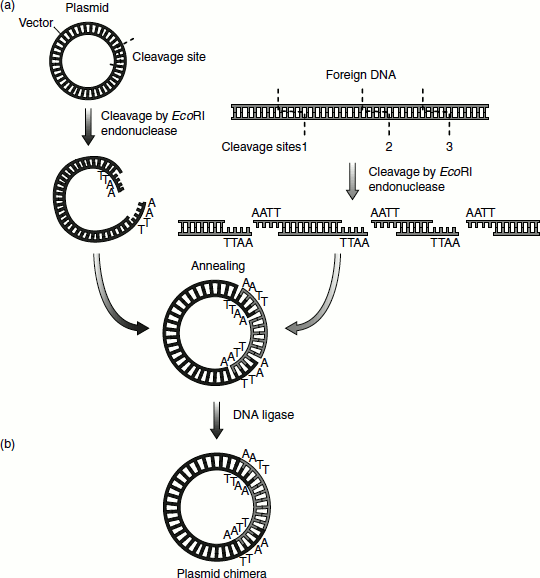
The blunt ends created using the action of restriction enzymes can be ligated with a similar blunt created in vectors by using:
Figure 9.7 Recombinant DNA production by sticky end ligation
- T4 DNA ligase,
- Linkers,
- Adapters and
- Homopolymer tailing.
T4 DNA ligase
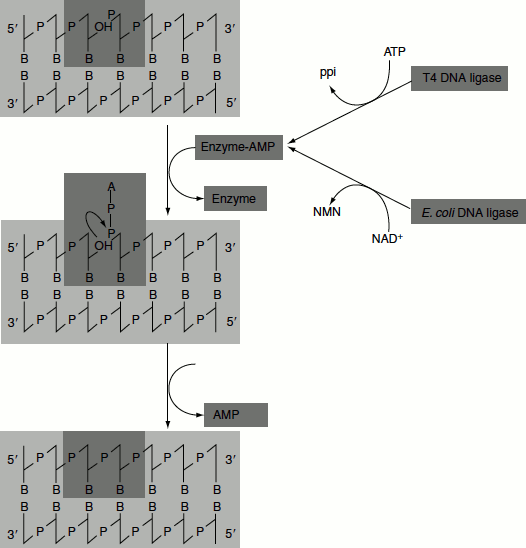
Blunt ends can be ligated using E. coli and phage DNA ligases, which seals single-stranded nicks between adjacent nucleotides in a duplex DNA chain. The enzymes act similarly; however, they differ in their cofactor requirements. The T4 enzyme requires ATP, while the E. coli enzyme requires NAD+. In each case, the cofactor splits and forms an enzyme-AMP complex. The complex binds to the nick, joining the 5′ phosphate and 3′-OH group, making a phosphodiester bond (Figure 9.8).
Figure 9.8 Ligation of DNA fragments by T4 DNA ligase
Linkers
These are chemically synthesized DNA molecules that are covalently joined to the ends of a DNA fragment or vector, in order to produce cohesive ends. Linkers are blunt-ended molecules but contain a restriction site. To the blunt-ended DNA of interest, these linkers can be attached by T4 DNA ligase. Cohesive ends are produced when these terminal extensions are cut by an appropriate restriction enzyme. Thus, cohesive ends corresponding to a particular restriction enzyme can be added to virtually any DNA molecule. It is important to realize that the use of high concentrations of linkers would inevitably cause multiple linkers to be attached to either side of the DNA molecule (Figure 9.9).
Adaptors
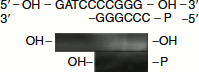
These are also short synthetic oligonucleotides such as linkers. However, the adaptor is synthesized such that it has one blunt end and one sticky end. In case of linkers, the restriction enzyme added may cut the target DNA (gene of interest) at an internal site. To avoid cutting up the target, adapters are used. The blunt end of the adaptor is not modified but the sticky end is modified, i.e., the 5′-PO4 group is removed. Therefore, two adaptor molecules cannot be linked as DNA ligase cannot ligate 5′-OH and 3′-OH. Therefore, the only possibility is the ligation of adaptor with the target DNA, i.e., the adaptors can be ligated to the DNA molecules but not to themselves. After the adaptors have been attached, the 5′-OH cohesive ends are then modified to 5′-phosphate by adding a phosphate group using the enzyme polynucleotide kinase. The modified DNA-adaptor molecules are now ready to be inserted into an appropriate cloning vector (Figure 9.10).
Figure 9.9 Linkers
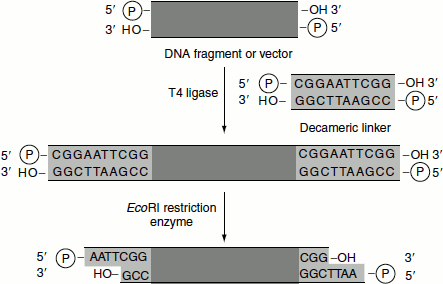
Figure 9.10 Adaptors
Homopolymer Tailing
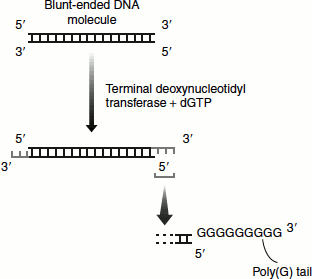
Terminal deoxynucleotidyl transferase catalyses the repetitive addition of mononucleotide units from deoxynucleoside triphosphates to the terminal 3′-hydroxyl group of a DNA molecule. The enzyme catalyses the addition of homopolymer tails to DNA fragments. This technique called homopolymer tailing is used for creating sticky ends on blunt-ended DNA fragments (Figure 9.11). For example, when DNA fragments are treated with the enzyme terminal deoxynucleotidyl transferase, in the presence of dATP, it results in the formation of poly-tails at the 3′-end of the DNA fragment.
Figure 9.11 Homopolymer tailing