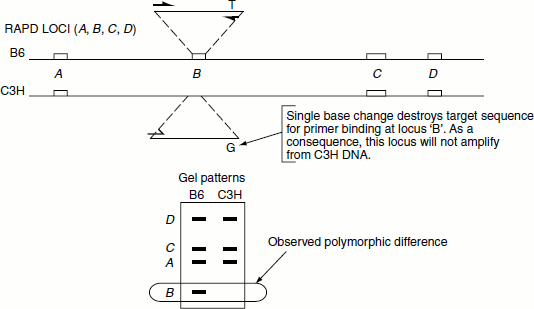
In this technique, short oligonucleotide (10 bp long) primers are used to amplify nanogram amounts of total genomic DNA by PCR. The oligonucleotide primers bind to complementary sequences in the template DNA and produce discrete DNA products. Nucleotide variation between different sets of template will result in the presence or absence of bands because of the changes in the priming sites. Chromosomal rearrangements such as insertions and deletions can be detected by this method. Amplification products from the same alleles in a heterozygote differ in length and can be detected by the presence or absence of bands in the random amplification of polymorphic DNA (RAPD) profile (Figure 12.11).
Each primer directs the amplification of several discrete loci in the genome. Allelism is, therefore, not distinguishable in RAPD patterns, i.e., it is not possible to distinguish whether a DNA segment is amplified from a locus that is heterozygous or homozygous. RAPD markers are, therefore, dominant.
Figure 12.11 RAPD
Applications of RAPD Analysis
RAPD technique is highly simple and economical. Therefore, it has wide range of applications in many areas of biology.
Genetic mapping
Genes are generally mapped by RFLP. This approach involves hybridization of a probe (usually a cloned fragment) to Southern blotted genomic DNA digested with restriction endonucleases. The RAPD approach has also been used to create saturated genetic maps in fish species; for example, Tilapia sp., Oreochromis niloticus and O. aureus.
Developing genetic markers
One of the most widely used applications of the RAPD technique is the identification of markers linked to the traits of interest without the necessity for mapping the entire genome.
Plant and animal breeding
Genetic improvement of animals is limited by the fact that most traits of economic importance are polygenic in nature and are influenced by a variety of external (environmental) and internal factors. Such traits are termed quantitative traits and polygenic loci involved in their expression are termed quantitative trait loci (QTL). To date, RFLP markers have been used as genetic markers to monitor the transmission of useful QTL alleles from generation to generation in the course of breeding programmes.