Ribosomes are compact ribonucleoprotein particles found in the cytosol of all cells, as well as in the matrix of mitochondria and the stroma of chloroplasts. Ribosomes are mechano-chemical systems that move along mRNA templates, co-ordinates the interactions between successive codons and the corresponding anticodons of the aminoacyl-tRNAs. Ribosomes also catalyse the formation of peptide bonds between adjacent amino acid residues. Prokaryotes and eukaryotes have similar ribosomes that are quite similar in both structure and function.
Prokaryotic Ribosome—70S Ribosome
The bacterial ribosomes contain 65 per cent RNA and 35 per cent protein. They have a diameter of about 18 nm and are composed of two unequal subunits with a sedimentation coefficient of 70S (Figure 5.2). The 50S subunit comprises of 34 proteins (L-proteins) and 23S and 5S rRNAs. The 23S rRNA is made up of 2,904 nucleotide residues and 5S rRNA of 120 nucleotide residues. The 30S subunit consists of 21 ribosomal proteins (S-proteins) and 16S rRNA molecule which contain 1,532 nucleotide residues (Figure 5.3 (a)).
Most ribosomal proteins are low molecular weight basic protein. The basic charge enables them to interact with negatively charged RNA. The RNA molecules within the ribosome have well-defined secondary structure and can interact with the ribosomal protein in precise manner. Prokaryotic ribosome can be split into RNA and protein components and then reassembled into active functional ribosome. Ribosomal proteins are present as single copy except L-7 and L-12 proteins.
Self-assembly of Ribosomes
Ribosomal subunits are capable of self-assembly from their macromolecular components. If the individual proteins and rRNAs composing ribosomal subunits that are mixed together in vitro under appropriate conditions of pH and ionic strength, spontaneous self-assembly into functionally competent subunits takes place without the intervention of any additional factors or chaperones. The rRNA acts as a scaffold upon which the various ribosomal proteins are attached. Ribosomal proteins bind in a specified order. Assembly of 30S subunits begins even as the rRNA precursor is being transcribed. The 5′-region of the 16S rRNA possesses a cluster of the strongest protein-binding sites.
Eukaryotic Ribosome—80S Ribosome
Eukaryotic cells have ribosomes in their mitochondria (and chloroplasts) as well as in the cytosol. The mitochondrial and chloroplastic ribosomes resemble prokaryotic ribosomes in size, organization, structure and function. This fact reflects the prokaryotic origins of these organelles. Eukaryotic cytosolic ribosomes are larger and considerably more complex.
Figure 5.2 Prokaryotic 70S ribosome
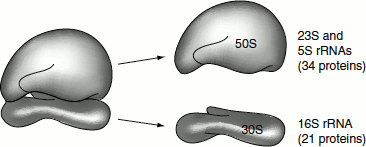
Figure 5.3 Prokaryotic and eukaryotic ribosome composition
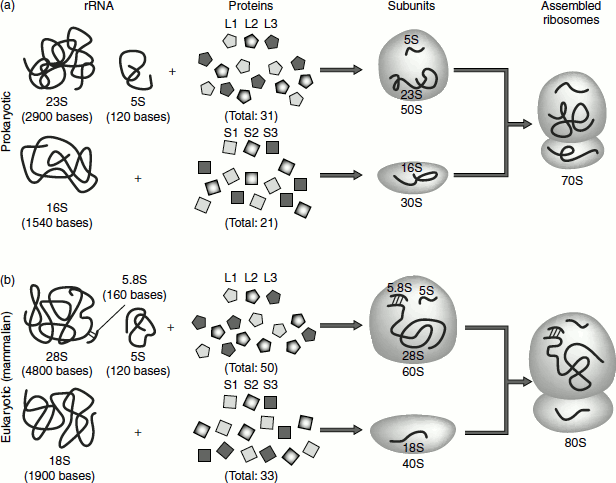
Eukaryotic ribosomes are made up of two subunits namely large 60S subunit and smaller 40S subunit. 60S subunit contains about 40–5 polypeptides and three rRNA components [28S rRNA, 5.8S rRNA and 5S rRNA] and 40S subunit contains about 30 polypeptides and 18S rRNA components (Figure 5.3(b) and Figure 5.4).
Figure 5.4 Eukaryotic 80S ribosome
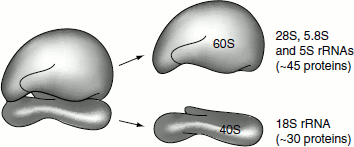
Figure 5.5 Ribosomal sites
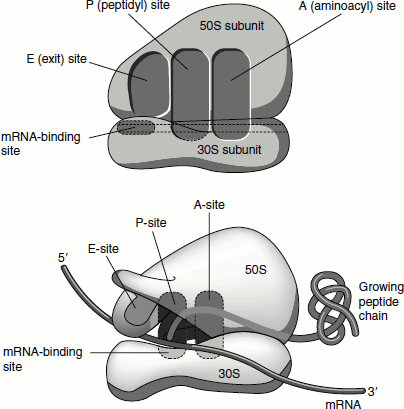
X-ray diffraction studies have revealed that ribosomes have some sites which are discussed in the following sections (Figure 5.5)
P-site (Peptide site)
It is located on 30S subunit and can also extent to 50S subunit. It is the site to which the initiating tRNA, i.e., N-formyl methionine-tRNAfmet binds. During translation, the peptide containing tRNA is present in this site and hence the name peptide site.
A-site (Amino acid site)
It lies closely to P-site. The incoming aminoacyl-tRNA binds to this site.
mRNA-binding site
It is located on 30S subunit. It is associated with 16S rRNA and carries the Shine-Dalgarno sequence which plays a key role in the mRNA binding.
Peptidyl transferase site
It lies somewhere between A-site and P-sites. 23S rRNA and some of the L-proteins are needed for their activity.
5S rRNA site
It is located near peptidyl transferase site.
E-site
It is the excision site which is located on 50S subunit. Empty tRNA after releasing their amino acids is freed from this site.