Endogenous DNA Damages
There are five main types of damage to DNA due to endogenous cellular processes (Figure 8.2). These include:
- Oxidation of bases [e.g., 8-oxo-7, 8-dihydroguanine (8-oxoG)]; generation of DNA strand interruptions from reactive oxygen species.
- Alkylation of bases (usually methylation), such as formation of 7-methylguanine, 1-methyladenine and 6-O-methylguanine.
- Hydrolysis of bases, such as deamination, depurination and depyrimidination.
- ‘Bulky adduct formation’ (i.e., benzo[a]pyrene diol epoxide-dG adduct).
- Mismatch of bases, due to errors in DNA replication, in which the wrong DNA base is substituted in a newly forming DNA strand or a DNA base is skipped over or mistakenly inserted.
Spontaneous damages can include the loss of a base, deamination, sugar ring puckering and tautomeric shifts.
Figure 8.2 Types of DNA damages
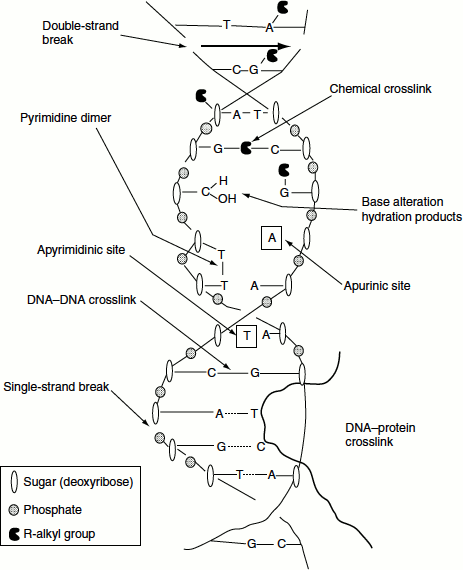
When compared to the nuclear DNA, the mitochondrial DNA is more subjected to oxidative stress, as oxidative phosphorylation results in the production of more reactive oxygen species. However, such damages are to a greater extent controlled by the action of super oxide dismutase.
Exogenous DNA Damages
These are of many forms. Some examples are:
- UV-B light: It causes pyrimidine dimer formation, crossing adjacent cytosine and thymine bases. This is referred to as ‘direct DNA damage’.
- UV-A light: It indirectly damages the DNA by creating free radicals.
- Ionizing radiations: They induce breaks in DNA strands; for example, cosmic rays, radioactive decay, etc.
- Thermal disruption: The rate of depurination increases at elevated temperatures and causes single-strand breaks.
- Industrial chemicals: Some chemicals such as vinyl chloride, hydrogen peroxide and polycyclic hydrocarbons oxidize, alkylate, esterify and cross-link the DNA bases.
DNA Damages and Mutations
DNA damages and mutations are the two major types of error in DNA. DNA damages and mutations are fundamentally different. Damages are physical abnormalities in the DNA. Damages can be recognized by enzymes and can be correctly repaired. In contrast, a mutation is a change in the base sequence of the DNA. Mutation cannot be recognized by enzymes once the base change is present in both DNA and consequently cannot be repaired.