There are four different patterns of gene regulations namely negatively inducible, negatively repressible, positively inducible and positively repressible gene regulations (Figure 7.1).
- ‘Negatively controlled inducible operons’ are not normally transcribed because a specific repressor protein that is bound to the operator region of the operon. Induction occurs when an inducer, a small molecule, binds to the repressor and alters its conformation, so that the repressor, with the altered conformation, can no longer bind to the operator and allow the transcription of the structural genes to proceed.
- ‘Negatively controlled repressible operons’ are normally transcribed, but when co-repressor binds to apo repressor (protein), this complex binds to the operator, which results in the inhibition of transcription.
- ‘Positively controlled inducible operons’ become active when a co-activator, a small molecule, binds to an apo activator, which alters its conformation, so that the complex can bind to a site near the operon and allow the transcription to be initiated.
- ‘Positively controlled repressible operons’ are the activator proteins that are normally bound to the operator. However, when a corepressor is bound by the activator, it is prevented from binding the DNA. This stops activation and transcription of the system (Table 7.1).
Figure 7.1 Types of gene regulation
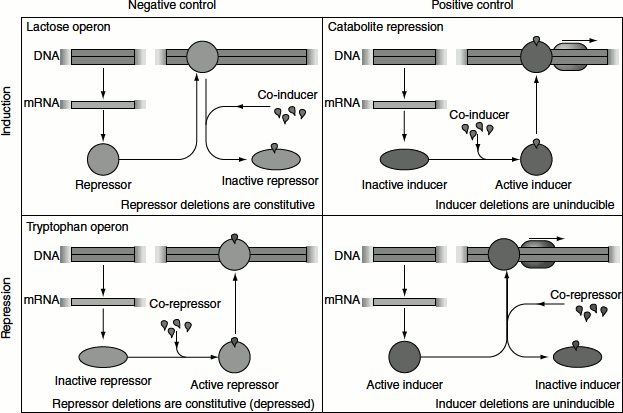
Table 7.1 Types of operon
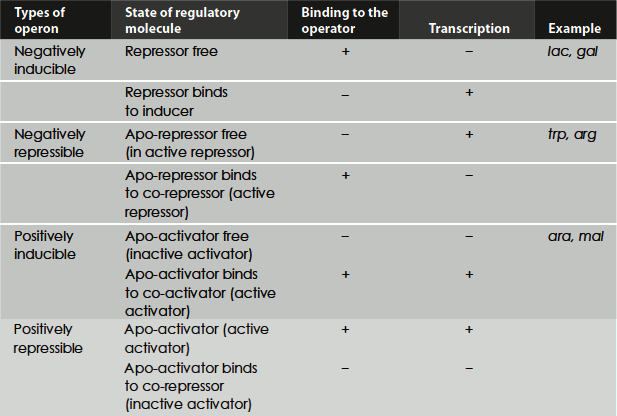
TYPES OF OPERONS