Wikipedia defines advection as “the transport of a substance or quantity by bulk motion.” Advection is a fundamental process in physics, engineering, and earth sciences. It governs how a solid object or a fluid moves in space because of background flow. When a swimmer is swimming against the current, they’re advected by the current, and their speed relative to the ground is lower than if there were no current at all. Advection is also why we find Saharan dust in the atmosphere over the Caribbean, Brazil, or northern Europe, or why garbage patches converge in the middle of ocean basins.
I mentioned earlier that in this chapter we’ll deal only with linear advection. The word linear here means that the background flow can be assumed to be constant, and not changing because of interactions with the advected object itself. As shown in figure 2.2, the object is moving with constant speed that’s independent from the object itself. In other words, the shape and position of the object do not influence the background flow. In the real world, however, this is almost never the case! Nonlinear advection of velocity is what creates turbulence. Small vortices in a stream, occasional bumps on commercial flights, and marbled texture that we see in photographs of Jupiter’s atmosphere are all examples of turbulence caused by nonlinear advection on different spatial scales. We’ll save the nonlinear advection for chapter 4; here, we’ll focus only on the linear part.
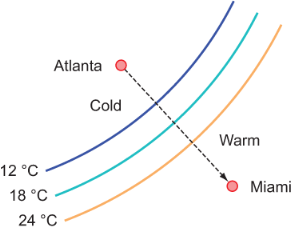
Figure 2.3 An illustration of a cold front moving from Atlanta toward Miami. Curved lines are contours of constant temperature. The dashed arrow shows the direction of front propagation.
To better understand how advection works, consider a cold front moving across the southeast United States (figure 2.3). A cold front is a large-scale weather phenomenon associated with mid-latitude cyclones. It typically moves from northwest to southeast in the Northern Hemisphere (southwest to northeast in the Southern Hemisphere) and brings cool and dry air in its wake. Where I live in South Florida, passages of cold fronts are eagerly anticipated because they bring refreshingly cool and dry air from the north.
Now I have a little exercise for you. Consider the following:
- The temperature is 12 °C in Atlanta and 24 °C in Miami.
- The distance between Atlanta and Miami is 960 kilometers.
- The front is moving toward Miami at a constant speed of 20 kilometers per hour (km/h).
Assume there are no other processes at play, and the change of temperature is uniform in space:
- What is the temperature gradient between Atlanta and Miami? Gradient is the difference of a quantity (here, temperature) between two locations, divided by the distance between them. In this case, the temperature gradient has units of °C/km.
- How many hours will it take for the temperature in Miami to fall to 12 °C?
- Finally, what will the temperature in Miami be after 24 hours? How did you arrive at this result?
Try to solve this problem with pen and paper. After you’ve worked through the exercise, you’ll have solved the linear advection equation, even if you didn’t realize it. The advection equation predicts the change of any quantity due to the spatial gradient of that quantity and the background flow. We’ll do the exact same calculation to predict the motion of the object in our simulator. You can find the solution to this exercise in the “Answer key” section near the end of this chapter.