Codon-anticodon Interactions
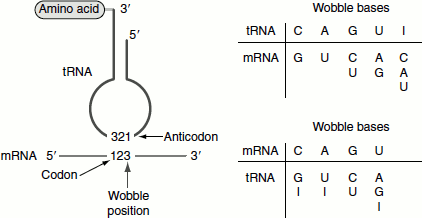
The genetic code is read in the 5′ → 3′ direction along the mRNA by sequential binding of the codons to the complementary anticodons of specific tRNA molecules. Each codon of the mRNA can be hydrogen bonded to a tRNA anticodon (present in the tRNA anticodon loop) consisting of complementary base sequence. The tRNA is oriented anti-parallel to the mRNA. The 1st, 2nd and 3rd bases of the mRNA codons pair respectively with the 3rd, 2nd and 1st bases of the tRNA anticodons obeying Watson-Crick base pairing rule. Thus, this codon-anticodon interaction enables the genetic code to be translated into specific amino acid sequence of the protein to be synthesized (Figure 5.1).
Wobble Hypothesis
It is a hypothesis given by Crick to explain how one tRNA molecule can accommodate more than one codons of amino acid. In order to explain the above anomaly, Crick proposed a word ‘wobble’ which according to him is the relative lose base pairing between base at the 3′-end of the codon and the complementary base at the 5′-end of the anticodon in the tRNA. The hypothesis proposes the following relationships:
- The first two bases of a codon always form strong Watson-crick base pair with the corresponding bases of anticodon and this confers most of the coding specificity.
- The first base of anticodon [5′ → 3′ direction] or the 3rd base [3′ → 5′ direction] called the wobble base allows the single tRNA to bind with more than one codon. The 3rd base [3′ → 5′ direction] of the codon which leads to lose base pairing is termed as ‘wobble’. The wobble permits tRNA to read more than one codon with the maximum limits of three codons. Figure 5.1 Codon-anticodon interaction
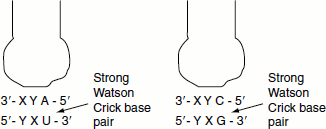
- If the ‘wobble’ base is ‘C’ or ‘A’ in the anticodon, then it recognize only one codon which mostly contain ‘G’ or ‘U’ respectively in its 3′ position. Here, ‘C’ and ‘A’ form Watson-Crick base pair with ‘G’ and ‘U’ respectively.
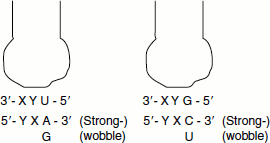
- When the first base in the 5′-end in the anticodon is ‘U’, then third base in codon can be either ‘A’ or ‘G’. The ‘U’ forms strong Watson-Crick base pair with ‘A’ and wobble pairing with ‘G’. Similarly, if ‘G’ is present at 5′-ends of anticodon, then ‘G’ forms Watson-Crick base pair with ‘C’ and wobble base pair with ‘U’.
- When ‘I’ or some other modified base is present at 5′-end of anticodon, then tRNA can recognize three different codons, all of which form a wobble base pairing at 3′ position of codon. The bases that can pair in this case are ‘A’, ‘U’ and ‘C’.
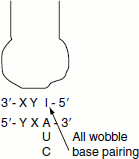
For example, the IGC anticodon of yeast alanine tRNA can pair with any of the codons GCU, GCC and GCA.

Thus, a part of degeneracy of the genetic code arises from wobble in the pairing of the third base of the codon. A minimum of 32 tRNAs are required to translate all 61 different codons for the amino acids.