Based on the arrangement of stones in the construction and the degree of refinement in the surface finish, the stone masonry can be classified broadly into the following two categories:
- Rubble masonry
- Coursed rubble
- Uncoursed rubble
- Random rubble
- Dry rubble
- Polygonal rubble
- Flint rubble
- Ashlar masonry
- Ashlar fine
- Ashlar rough tooled
- Ashlar rock or quarry faced
- Ashlar chamfered
- Ashlar block-in course
15.3.1 Rubble masonry
In this type of construction, stones of irregular sizes are used. The stones as obtained from the quarry are taken to be used in the same form or are broken and shaped into suitable sizes by means of a hammer as the work proceeds. The strength of the rubble masonry mainly depends on:
- The quality of mortar.
- The use of the long stones at frequent interval for proper bonding.
- The proper filling of the mortar between the spaces of stones.
15.3.1.1 Coursed rubble masonry
In this type of rubble masonry, the heights of stones vary from 50 mm to 20 cm. The stones are stored before the work commences. The masonry work is then carried out in courses such that the stones in a particular course are of equal heights. This type of masonry is used for the construction of public buildings and residential buildings. The coursed rubble masonry is further divided into three categories.
- Coursed rubble masonry I sort: In this type, stones of the same height are used and the courses are of the same heights. The face stones are dressed by means of a hammer and the brushings do not project by more than 40 mm. The thickness of the mortar joint does not exceed 10 mm (Figure 15.1).
- Coursed rubble masonry II sort: The stones to be used are of different heights. The courses need not be of equal heights. Only two stones are to be used to make up the height of one course. The thickness of the mortar joint is 12 mm (Figure 15.2).
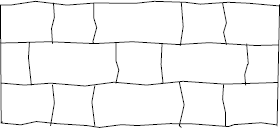 Figure 15.1 Coursed rubble masonry I sort
 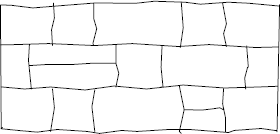 Figure 15.2 Coursed rubble masonry II sort
 - Coursed random rubble III sort: The stones to be used are of different heights, the minimum being 50 mm. The courses need not be of equal heights. Only three stones are to be used to make up the height of one course. The thickness of the mortar joint is 16 mm (Figure 15.3).
15.3.1.2 Uncoursed rubble masonry
In this type of rubble masonry, the stones are not dressed. However, they are used as they are available from the quarry, except by knocking out some corners. The courses are not maintained regularly. The larger stones are laid first and the spaces between them are then filled by means of spalls. The wall is brought to a level every 30–50 cm. This type of rubble masonry being cheaper is used for the construction of compound walls, garages, labour quarters, etc. (Figure 15.4).
15.3.1.3 Random rubble masonry
In this type of rubble masonry, stones of irregular sizes and shapes are used. The stones are arranged to have a good appearance. It is to be noted that more skill is required to make the masonry structurally stable. If the face stones are chisel dressed and the thickness of mortar joints does not exceed 6 mm, it is known as random rubble masonry I sort. If the face stones are hammer dressed and the thickness of mortar joints does not exceed 12 mm, it is known as random rubble masonry II sort. This type of masonry is used for construction of residential buildings (Figure 15.5).
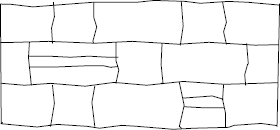
Figure 15.3 Coursed rubble masonry III sort
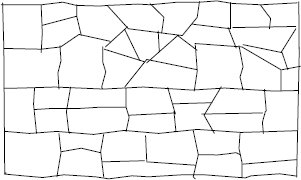
Figure 15.4 Uncoursed rubble masonry
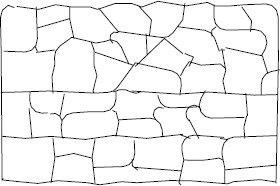
Figure 15.5 Random rubble masonry
15.3.1.4 Dry rubble masonry
This is just similar in construction to the coursed rubble masonry III sort except that no mortar is used in the joints. This type of construction is the cheapest, but it requires more skill in construction. It is extensively used for compound walls pitching on bridge approaches, retaining walls, etc. In order to prevent the displacement of stones and to make the work more stable, the two courses at the top and about 50 cm length at the ends are sometimes built in mortar.
15.3.1.5 Polygonal rubble masonry
In this type of masonry, the stones are hammer dressed and the stones selected for face work are dressed in an irregular polygonal shape. Thus, the face joints are seen running in an irregular shape in all directions. It is to be noted that more skill is required in this type of construction.
15.3.1.6 Flint rubble masonry
In this type of masonry, the stones are used as flints that are irregularly shaped nodules of silica. The width and thickness vary from 80 mm to 15 cm and the length varies from 15 to 30 cm (Figure 15.6).
15.3.2 Ashlar masonry
This is costlier, high grade and superior quality masonry. This is built from accurately dressed stones with uniform and very fine joints of about 3 mm thickness. By arranging the stone blocks in various patterns, different types of appearances can be obtained. The backing of ashlar masonry walls may be built of ashlar or rubble masonry.
15.3.2.1 Ashlar fine masonry
At all beds, joints and faces stones should be dressed perfectly so that they conform to the desired pattern. The size of the stones to be laid in regular courses should not be less than 300 mm in height. The width of the stones should not be less than the height of the course. In addition, the length of the stones should be more than two times the height of the course. Generally, face stones are laid as headers and stretchers alternatively. The header comes under the middle portion of the stretchers. In order to break the continuous vertical joints, the stones in the adjacent layers should have a lap of more than half of the height of the course. All the joints, either horizontal or vertical, should be made of fine mortar with a maximum thickness of 3 mm. The broken edges of the stones should not be visible at the joints (Figure 15.7).
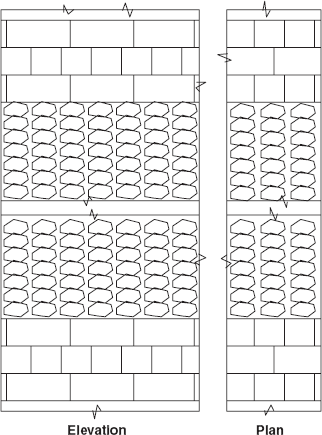
Figure 15.6 Flint rubble masonry
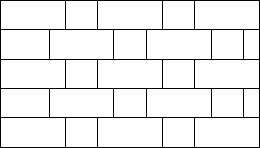
Figure 15.7 Ashlar fine masonry
15.3.2.2 Ashlar rough tooled
The exposed faces of this type of masonry should be given a fine dressed chisel drafting of about 25 mm width. In between the drafts, portions should be roughly tooled. The joint thickness should be 6 mm.
15.3.2.3 Ashlar rock or quarry faced
In this case, the exposed faces of the facing stones between the chisel draftings all around are left undressed. However, the projections of sizes more than 8 cm are broken. All other specifications regarding the sizes of the stones and the bond are kept similar to that of ashlar rough tooled masonry.
15.3.2.4 Ashlar chamfered
In this type of ashlar masonry, the strip is provided as above. However, it is chamfered or bevelled at an angle of 45 degrees by means of a chisel for a depth of about 25 mm. Another strip 12 mm wide is then provided on the remaining exposed face of the stone and the surface inside this strip is left in the same form as received from the quarry. The large bushings projecting out to more than 80 mm are removed by a hammer. A neat appearance of the grooved joints is obtained with the help of this type of construction.
15.3.2.5 Ashlar block in course masonry
This type of masonry occupies an intermediate position between the rubble masonry and ashlar masonry. The faces of the stones are generally hammer dressed and the thickness of mortar joints does not exceed 6 mm. The depth of courses varies from 20 to 30 cm. This type of construction is used for heavy engineering works.
15.3.3 Mortars used for stone masonry
Generally, 1:3 cement–sand mortar is used for stone masonry work. If improved workability is required, 15 per cent of the cement is replaced by lime. Rich mortar is used for the pointing works.
15.3.4 Joints in stone masonry
The joints in masonry work are as follows (Figure 15.8):
- Butt joint: The squared faces of the adjacent stones abut each other.
- Lapped or rebated joint: This is used for arches, stones laid on slopes, etc.
- Table joint: Here, lateral movement is prevented and this is more suitable where lateral pressure is high.
- Tongued and grooved joint: This joint prevents sliding of stones. Here, a projection of one stone fits into the depression or groove on the other stone.
- Dowel joint: Here also lateral movement is prevented with a small key as in Figure 15.8.
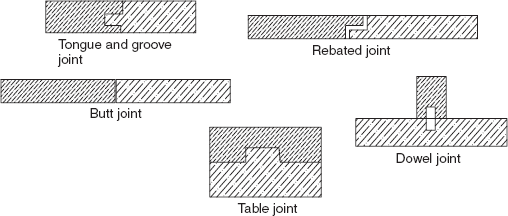
Figure 15.8 Joints in stone masonry