15.6.1 Stretcher bond
In this type of bond, all the bricks are laid with their length in the direction of the wall. The stretcher bond is useful for one-brick partition walls as there are no headers. This bond does not develop proper internal bond and it should not be used for walls having thickness greater than that of one-brick wall (Figure 15.9).
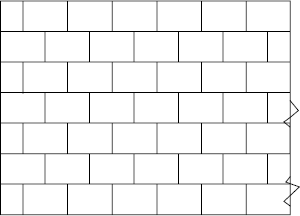
Figure 15.9 Stretcher bond
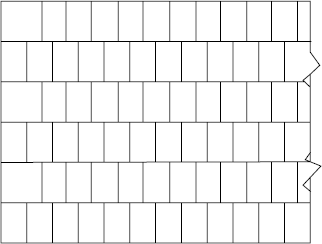
Figure 15.10 Header bond
15.6.2 Header bond
In this type of bond, all the bricks are laid with their ends towards the face of the wall. Thus, the bond does not have the strength to transmit pressure in the direction of the length of the wall. This bond is used for curved surfaces (Figure 15.10).
15.6.3 English bond
In this type of bond, alternate courses of headers and stretchers are laid. It is necessary to place queen closers after the first header in the heading course for breaking the joints vertically (Figures 15.11, 15.12 and 15.13).
- A queen closer must be provided after a quoin header or first header. A header course should never start with a queen closer.
- Each alternate header should be centrally placed over a stretcher.
- Continuous vertical joints should not be allowed except at the stopped end.
- In case the wall thickness is equivalent to an even number of half bricks, the wall shall present similar appearance in both faces.
- In case the wall thickness is equivalent to an odd number of half bricks, the same course shall have stretcher on one face and header on the other face.
- Only headers should be used for the hearting of the thicker walls.
- The joints on the header course should be made thinner than those in the stretcher course. This is because of the fact that the number of vertical joints in the stretcher course is half the number of joints in the header course.
15.6.4 Flemish bond
In this type of bond, the headers are distributed evenly and, hence, it creates a better appearance than the English bond.
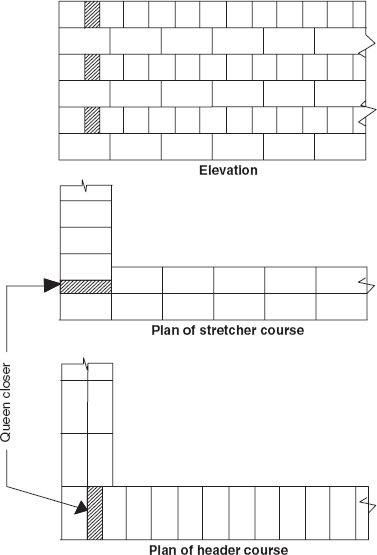
Figure 15.11 English bond – 1 brick thick
In the flemish bond, for every course the headers and stretchers are placed alternatively. The queen closer is put next to the quoin header in alternate courses to develop the face lap. Every header is centrally supported over a stretcher below it.
The flemish bond is divided into two groups.
15.6.4.1 Double Flemish bond
In this bond, alternate headers and stretchers are laid to each course. This type of bond is better in appearance than the English bond. The facings and the bracings are of the same appearance. Brickbats are used in the case of walls having thickness equivalent to an odd number of half bricks. The queen closer is placed next to the quoin header in alternate courses in order to break the continuity of the vertical joints (Figure 15.14).
15.6.4.2 Single Flemish bond
The face elevation is of flemish bond and the filling as well as backing are of the English bond. This type of bond is an attempt to combine the strength of the English bond with the appearance of the flemish bond. In order to construct this bond, a wall of minimum thickness of 1½ bricks is required. The bricks in the same course do not break joints with each other. The joint is straight. In this bond, short continuous vertical joints are formed. The following table gives the comparison between English and Flemish bonds.
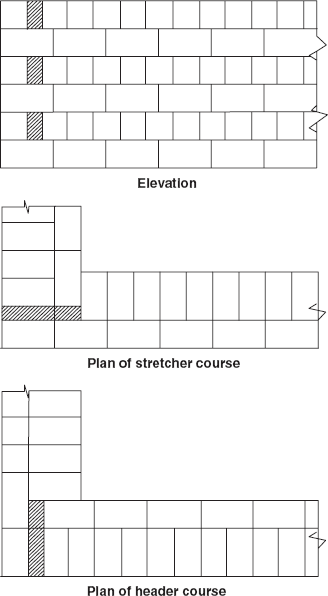
Figure 15.12 English bond – 1½ brick thick
A Comparison Between English and Flemish Bonds
| English bond | Flemish bond |
|---|---|
| More compact and strong for walls having thickness more than 1½ bricks | Less compact and less strength |
| Less pleasing in appearance from facing | Better appearance in the facing |
| Strict supervision and skill are not required | Good workmanship and careful supervision required |
| More in cost | Cheaper in cost |
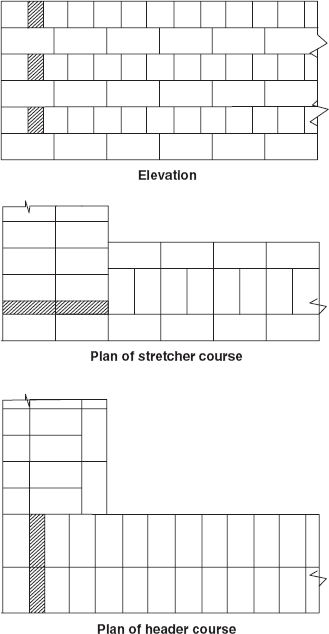
Figure 15.13 English bond – 2 bricks thick
15.6.5 Garden-wall bond
This type of bond is employed for the construction of garden walls, compound walls, boundary walls, etc.
15.6.5.1 English garden-wall bond
This type of bond comprises of one course of header to three or five courses of stretchers. In order to break the continuity of vertical joints, a queen closer is laid next to the header of the heading course and the middle course of stretchers is started with a header (Figure 15.15).
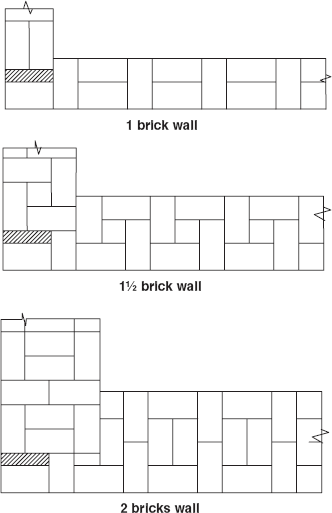
Figure 15.14 Courses 2, 4, 6, etc. of double Flemish bond
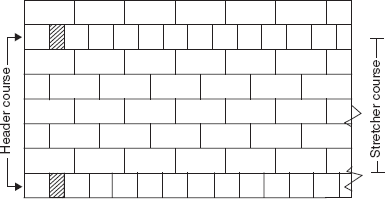
Figure 15.15 Garden-wall English bond
15.6.5.2 Flemish garden-wall bond
In this type, each course contains one header to three or five stretchers. A three-fourth brickbat is placed next to the quoin header in every alternate course to develop the necessary lap. A header is placed centrally over each middle stretcher (Figure 15.16).
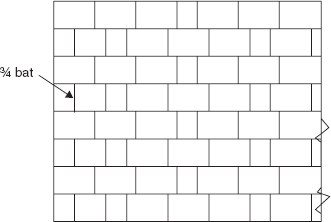
Figure 15.16 Garden-wall Flemish bond
15.6.6 Dutch bond
This type of bond is a modified form of English bond. The corners of the wall provided with the Dutch bond are quite strong. The alternate courses in this type of bond are headers and stretchers. In the stretchers course, a three-fourth bat is used as quoin. A header is placed next to the three-fourth bat in every alternate stretcher (Figure 15.17).
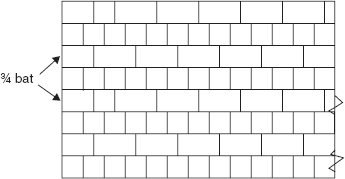
Figure 15.17 Dutch bond
15.6.7 Herringbone bond
In this bond, the bricks are placed at an angle of 45 degrees from the central line in both the directions. This type of bond is used in the case of walls having thickness of more than four bricks or for paving (Figure 15.18).
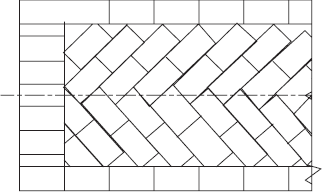
Figure 15.18 Herringbone bond
15.6.8 Zigzag bond
This type of bond is very much similar to the herringbone bond. The only difference in this type of bond is that the bricks are laid in a zigzag way. It is adopted mainly in paving brick floors (Figure 15.19).
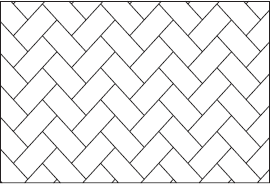
Figure 15.19 Zigzag bond
15.6.9 Brick on edge bond
In this type of bond, the bricks are laid on edge instead of bed. This bond is economical as it consumes less number of bricks and less quantity of mortar. However, it is not strong and, hence, is used for the construction of garden walls, compound walls, partition walls, etc. In this bond, the bricks are laid as headers and stretchers in alternate courses in such a way that the stretchers are laid at the edge.
15.6.10 Facing bond
In this type of bond, bricks of different thickness are used in the facing and backing of the walls. In this case, a header course is placed after several stretcher courses. The distance between the successive heading courses is equal to the least common multiple of the thickness of backing and facing bricks.