Compaction of concrete is the method adopted for expelling the entrapped air from the concrete. If the air is not removed fully, the concrete loses strength considerably. Figure 16.3 shows the relation between loss of strength and air voids left due to lack of compaction.
It can be seen from Figure 16.3 that 5 per cent voids reduce the strength of concrete by about 30 per cent and 10 per cent voids reduce the strength by over 50 per cent. Therefore, it is imperative that 100 per cent compaction is one of the most important points to be kept in mind in good concrete-making practices.
16.9.1 Methods of compaction
The following methods are generally adopted for the compaction of concrete:
- Hand compaction
- Rodding
- Ramming
- Tamping
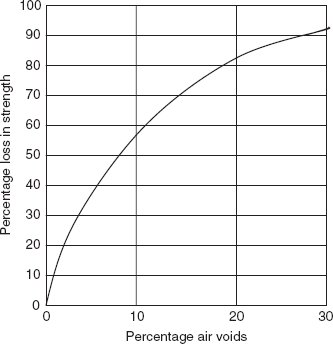 Figure 16.3 Relation between percentage loss in strength and percentage air voids
- Compaction by vibration
- Internal Vibrator (Needle vibrator)
- External Vibrator (Formwork vibrator)
- Table vibrator
- Platform vibrator
- Surface vibrator (Screed vibrator)
- Vibratory roller
- Compaction by pressure and jolting
- Compaction by spinning
16.9.1.1 Hand compaction
Hand compaction is adopted in the case of small unimportant works. This method is also used in situations where a large quantity of reinforcement is used, which cannot be normally compacted by mechanical means. When hand compaction is adopted, the consistency of concrete is maintained at a higher level. Hand compaction consists of rodding, ramming or tamping.
Rodding is nothing but poking the concrete with a rod about 2 m long and 16 mm diameter to pack the concrete between the reinforcement and sharp corners and edges. Rodding is done continuously over the complete area to effectively pack the concrete and drive away entrapped air.
Ramming should be done with care. Light ramming can be permitted in unreinforced foundation concrete or in ground floor constructions. Ramming should not be permitted in the case of reinforced concrete or in upper floor constructions, where the concrete is placed on formwork placed on struts.
Tamping is one of the usual methods adopted in compacting roof or floor slabs or road pavement where the thickness of concrete is comparatively less. Tamping consists of beating the top surface by a wooden cross beam. Since the tamping bar is sufficiently long, it not only compacts but also levels the top surface across the entire width.
16.9.1.2 Compaction by vibration
To compact concrete with low water–cement ratio, mechanically operated vibratory equipments must be used. Compaction of concrete by vibration has almost completely revolutionized the concept of concrete technology, making possible the use of low slump stiff mixes. Different methods for vibrating the concrete can be adopted.
Internal vibrator
Of all the vibrators, the internal vibrator is the most commonly used. It is also called ‘needle vibrator’, ‘immersion vibrator’ or ‘poker vibrator’. This essentially consists of a power unit, a flexible shaft and a needle. The needle’s diameter varies from 20 to 75 mm and its length varies from 25 to 90 cm. A bigger needle is used in the construction of mass concrete dam.
External vibrator (Formwork vibrator)
Formwork vibrators are used for concreting columns, thin walls or in the casting of precast units. The machine is clamped to the external wall surface of the formwork. The vibration is given to the formwork so that the concrete in the vicinity of the shutter gets vibrated. Since the vibration is given to the concrete indirectly through the formwork, it consumes more power and its efficiency is less than the internal vibrator.
Table vibrator
This is a special type of formwork vibrator, where the vibrator is clamped to the table or the table is mounted on springs, which are vibrated transferring the vibrations to the table. It is commonly used for vibrating concrete cubes. It is adopted mostly in laboratories and in making small, precise precast RCC members.
Platform vibrator
Platform vibrator is nothing but a table vibrator, but it is larger. It is used in the manufacture of large prefabricated concrete elements such as electric poles, railway sleepers and prefabricated roofing elements.
Surface vibrator
Surface vibrators are also known as ‘screed board vibrators’. A small vibrator placed on the screed board gives an effective method of compacting and levelling thin concrete members. Mostly, floor slabs and roof slabs are so thin that an internal vibrator or any other type of vibrator cannot be used. In such cases, the surface vibrator can be effectively used.
Vibratory roller
One of the recent developments of compacting very dry and lean concrete is the use of vibratory roller. Such concrete is known as roller compacted concrete. This method is mainly used for the construction of dams and pavements. Heavy roller, which vibrates while rolling, is used for the compaction of dry lean concrete.
16.9.1.3 Compaction by pressure and jolting
This is one of the effective methods of compacting very dry concrete. This method is often used for compacting hollow blocks, cavity blocks and solid concrete blocks. The stiff concrete is vibrated, pressed and given jolts. By employing great pressure, a concrete of very low water–cement ratio can be compacted to yield very high strength.
16.9.1.4 Compaction by spinning
Spinning is one of the recent methods of compaction of concrete. This method of compaction is adopted for the fabrication of concrete pipes. The plastic concrete when spun at a very high speed gets well compacted by centrifugal force.