The doors commonly used in buildings are classified into various types depending upon several factors or aspects like materials used in the manufacture of doors, arrangement of door components, method of construction and their working operation.
17.4.1 Battened and ledged door
This is the simplest form of door, which is frequently used for narrow openings. The use of this type of door is preferred where cost is the main factor rather than the strength and appearance. This door consists of vertical boards known as battens, which are secured by horizontal pieces known as ledges. Usually, there are three ledges, namely top ledge, middle ledge or lock edge and bottom edge. The outer edges of the ledges are generally chamfered. The bottom and middle ledges are sometimes wider than the top ledges. The battens secured by means of tongued and grooved joint are either V-jointed or beaded (Figure 17.1).
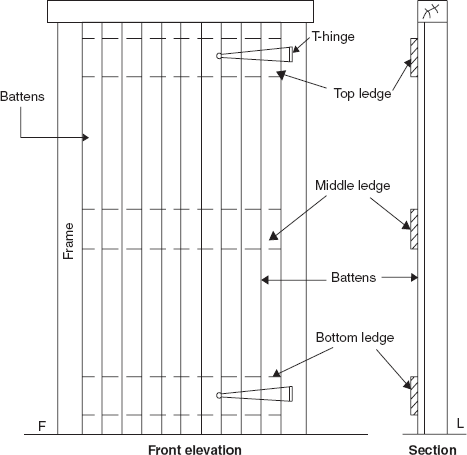
Figure 17.1 Battened and ledged door
The sizes of the door components are as follows:
- Vertical battens: width is 10–20 cm; thickness is 2–4 cm
- Top ledge: width is 10 cm; thickness is 3-4 cm
- Middle and bottom ledge: width is 15–20 cm; thickness is 3-4 cm
17.4.2 Battened, ledged and braced door
This door is a modification over battened and ledged doors in which additional diagonal members called braces are provided to increase its rigidity and, hence, the strength. These braces act as struts as they are made to incline upwards from the hanging edge. By doing so, the tendency of dropping at the nose, in the case of wider doors, is prevented. Thus, these types of doors can be used for wider openings.
Braces: width is 10–15 cm; thickness is 3-4 cm. All other members are of the same size as in the above case.
This door is commonly adopted for bathrooms where the appearance is not so important as economy (Figure 17.2).
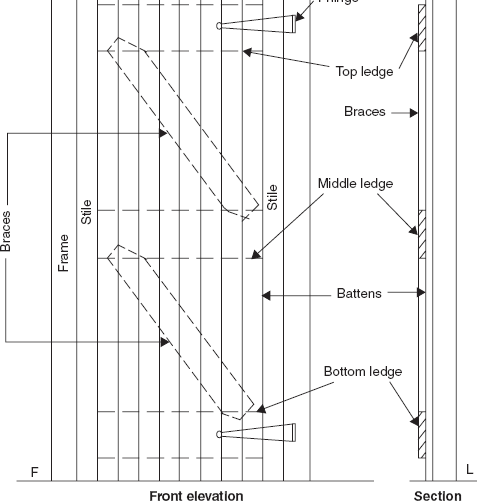
Figure 17.2 Battened, ledged and braced door
17.4.3 Battened, ledged and framed door
This door is provided with a framework for shutters to have better strength and appearance than the ordinary battened and ledged doors. This door consists of two vertical styles, three ledges or rails, bottom, top and middle and battened fixed in the framework. Battens and ledges are provided as usual. Stiles are generally 10 cm in width and 4 cm in thickness (Figure 17.3).
17.4.4 Battened, ledged, framed and braced door
This door is a modification over the previous type in which additional members known as braces have been introduced to increase its strength, durability and appearance. This type of door is largely used for external work. This door has a framework consisting of two stiles, three ledges on rails, battens and two inclined braces. Generally, the thickness of the top rail and the stiles is same and equal to that of the braces and batten together. The braces are 1.5 × 12 cm (Figure 17.4).
17.4.5 Framed and panelled door
This type of door is very commonly used and is constructed in various designs. The object of using such a door is to obtain a framework in which the tendency of shrinkages is reduced and the appearance enhanced. This type of door consists of a frame in which the panels are fitted. A double-leafed door is with modular dimensions of frame as 120 cm width and 10 cm height.
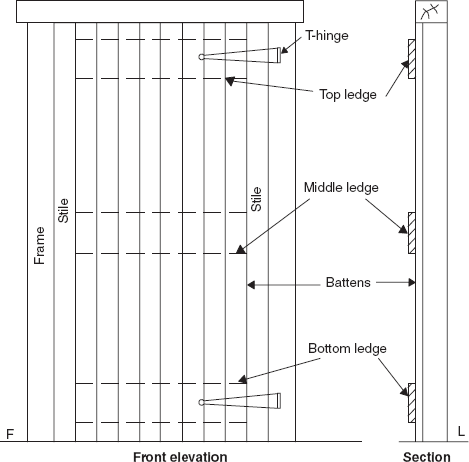
Figure 17.3 Battened, ledged and framed door
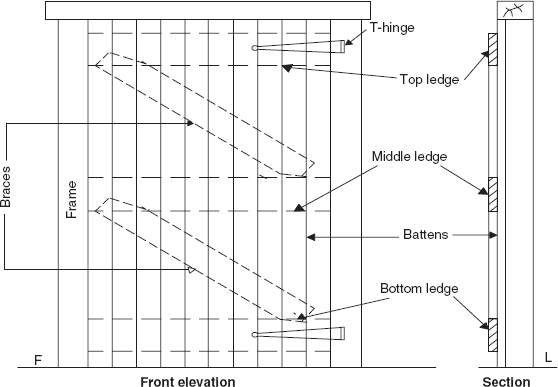
Figure 17.4 Battened, ledged, framed and braced door
- The stiles are continuous from top to bottom for the full height.
- The rails, top rail, bottom rail and lock rail, are jointed to the stiles.
- The frame consists of narrow pieces, mortised and tenoned to each other and grooved on all the inside faces to receive the panels.
- Bottom and lock rails are made of bigger size and are stronger than top and frieze rails.
- It is generally recommended that the minimum width of stiles should not be less than 10 cm and for lock and bottom rails not less than 15 cm. The thickness of the shutter frame is usually kept 4-5 cm, but the actual value depends upon several factors like door size, situation of door, type of work, thickness of panels and size of the moulding (Figure 17.5).
17.4.6 Glazed or sash door
Sometimes, the doors either fully glazed or partly glazed and partly panelled are used to supplement the natural lighting provided by windows or to make the interior of one room visible from another (Figure 17.6). The glazed or sash door is extensively used these days in residential as well as public buildings. When sufficient light is required to be admitted through doors then fully glazed doors are provided (Figure 17.7). In the case of partly glazed and partly panelled doors, the usual proportion of glazed portion to the panelled portion is kept 2:1.
17.4.7 Flush door
Flush doors are becoming more popular these days for residential and public buildings because of several good characteristics like pleasing appearance, simplicity of construction, economy, strength and high durability. A flush door consists of a skeleton or a hollow framework of rails and stiles and it is covered on both the sides with laminated boards or plywood. This door has, therefore, fewer perfectly flush and joint surfaces on both the sides. The nominal thickness of flush door shutters varies from 25 to 40 mm depending upon the type of door (Figure 17.8).
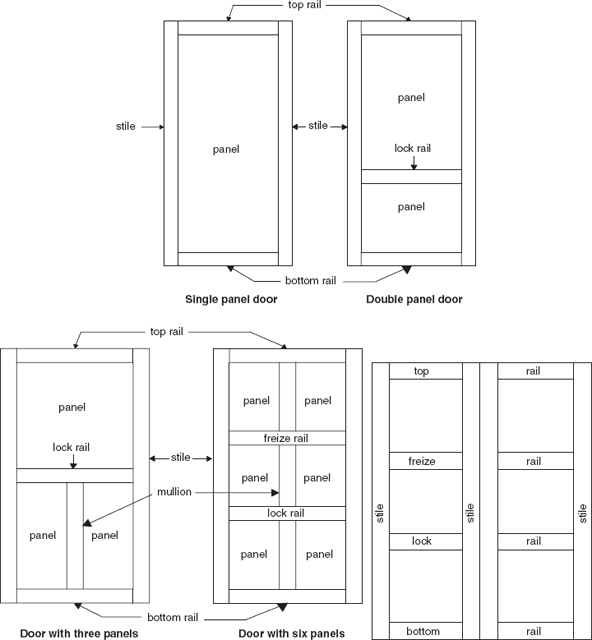
Figure 17.5 Framed and panelled door
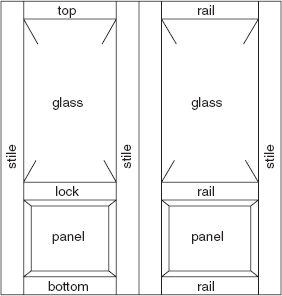
Figure 17.6 Partly panelled and partly glazed door
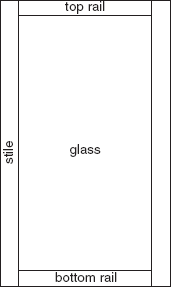
Figure 17.7 Fully glazed door
- Solid Core Flush Door: This door consists of a core of strips of a wood glued together under great pressure and faced on each side by plywood sheets. The laminated strips are not less than 20 mm in width and are glued edge to edge. The solid core or limited flush doors are heavy and require more material for their construction.
- Hollow and Cellular Core Flush Door: In this type, the frame consists of stiles and top, bottom and intermediate rails, each not less than 7.5 cm wide, and this frame is covered on both the sides by sheets of plywood. Sometimes, the hollow wood frame is filled with granulated cork or any light material instead of being left hollow. To ensure thorough circulation of air within the framing, ventilation holes are provided.
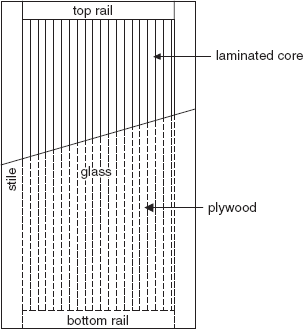
Figure 17.8 Flush door
In the case of hollow core shutters, vertical battens not less than 25 mm wide are so fixed on the rails that they provide void spaces, each not more than 500 cm2. Moreover, their void spaces or hollow portions should be equally distributed. In the case of cellular core shutters, vertical battens and horizontal battens or ribs not less than 24 mm wide and made up of strips of wood and plywood or blocks of compressed wood are so fixed that they provide a grid of void spaces, each not more than 25 cm2 in area.
17.4.8 Louvered door or ventilated door
The use of this door is recommended when privacy combined with natural ventilation and quietness for rest is desired, because it allows free passage of air even when closed. These doors are not much favoured since they are difficult to clean. The louvers are made either movable by connecting them to the pivot by means of hinges or fixed into the stile. In the case of movable type, the upward or downward movement of louvers is carried out by lowering and raising the pivot, respectively. Louvers are made of glass or timber.
17.4.9 Wire gauzed door
This door is used where it is desired to allow free air into the room and avoid the nuisance of insects, mosquitoes, etc. The wire gauzed door consists of vertical stiles and horizontal rails with fine mesh galvanized gauze fixed to the shutters by a bead braded or nailed to the frame. Generally, the frame is provided with two types of shutters. Shutters of ordinary panelled type are provided on the front side and are made to open to the outside of the room, whereas another type of shutter is provided with a wire gauze and is made to open to the inside of the room.
17.4.10 Collapsible steel door
The collapsible steel door neither requires hinges for opening and closing the shutters nor any frame for hanging them. This door is extensively used for the main entrance of residential buildings, shops, garages, etc. where the width of the door is large and the space is sufficient to provide two-leafed hinged shutters. This door being very strong can be used in exposed situations to safeguard against robbers. It may be made of single or double shutters depending upon the size of the opening.
It is fabricated from vertical pieces of rolled steel channels 16–20 mm wide, joined together with the hollows of the channel on the inside, leaving a vertical gap of 12–20 mm between them. Rollers are provided both at their top and bottom or at the top in some case. The doors can be opened or closed by a slight pull or push. The vertical channel pieces are spaced at 10–12 cm centre to centre and are joined to one another by means of hoop iron cross pieces or flats 16–20 mm wide and 5 mm thick, which allow the door to open or fold (Figure 17.9).
17.4.11 Rolling steel shutter door
This door is capable of being rolled up at the top easily and causes no obstruction either in the opening or floor space. It is commonly used for the main entrance of shops, garages, godowns, etc. It is sufficiently strong and offers proper safety to the interior when closed. A rolling steel door consists of a frame, a drum and a shutter of thin steel plates or iron sheets of thickness about 1 mm and width varying up to 6 m. Steel guides are provided on the sides for the movement of shutters. The door is counterbalanced by means of helical springs enclosed in the drum.
17.4.12 Revolving door
This door provides entrance on one side and exit on the other side simultaneously. It keeps the opening automatically closed when it is not in use. These doors are provided where there is constant foot traffic of people entering and leaving the entrance of public buildings. Revolving doors consist of four upright cross wings, i.e., shutters which are arranged diagonally on the sides of a centrally placed pivot. These shutters revolve about this pivot or vertical axis.
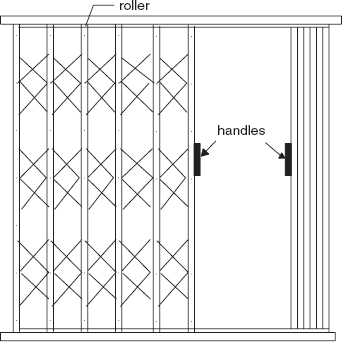
Figure 17.9 Collapsible door
17.4.13 Side sliding door
In this type of doors, the need of hinges for fixing shutters to frames of doors is eliminated. It is commonly used for the entrance of godowns, sheds, shops, garages, etc. The shutter of this type of door consists of one or several panels, which can slide either on one side or both the sides. These doors are operated by sliding the doors on the sides with the help of runners at the top and guides at the bottom.