Windows are provided in the wall openings for admission of light, free circulation of air and sunshine. As a general rule, the minimum area of a window or windows should be one-tenth of the floor area of the room and at least half of this area should be made open for ventilation.
17.5.1 Casement window
The simplest type of casement window consists of a square or rectangular window frame of metal or wood, with a casement hinged at one side to the frame to open out. The side-hinged opening part of the window is known as the casement and it consists of glass surrounded and supported by metal or timber strips. The casement is hinged to open out because an outward opening casement can more readily be made to exclude rain and wind than one opening inwards. The usual sizes of the component parts of a casement window are as follows (Figure 17.10):
| Width × thickness | |
|---|---|
| Vertical stiles, top rails and bottom rails | 7 × 3.5 cm–9.5 × 3.5 cm |
| Heads, mullions and transoms | 9 × 7 cm–12 × 7 cm |
| Sash or glazing bars | 3.5 × 3.5 cm |
| Maximum size of the shutter | 60 × 120 cm |
17.5.2 Double hung window
This window has a pair of shutters one above the other which can slide within the grooves in the frame. Two metallic weights are connected to each shutter by a cord or chain passing over pulleys. The following features regarding double hung windows should be noted.
- In these windows, the shutters can be made to open to the desired extent and, hence, ventilation can be controlled. Moreover, the sliding of the shutters vertically facilitates in the cleaning of the shutter.
- A special frame known as the boxed frame or cased frame is employed for sashes sliding vertically. This frame consists of two vertical members, a head and a sill, and a parting bead. The function of the parting bead is to separate the two shutters or sashes when they are opposite to each other.
 Figure 17.10 Wooden casement window
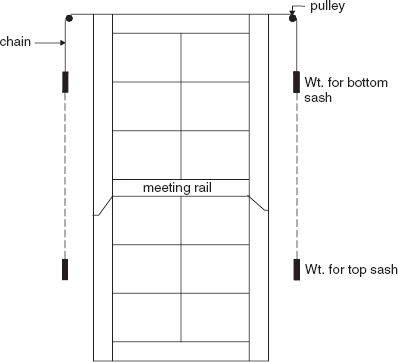 Figure 17.11 Double hung window
 - The shutters are constructed as usual and consist of two stiles, a top rail, a bottom rail and sash bars. The thickness of the shutters is kept to about 5 cm.
- The metallic counter-weights usually of cast iron are made as heavy as the sash or shutter so that little effort is required to slide the sashes up or down (Figure 17.11).
17.5.3 Sash or glazed window
A sash consists of stiles, rails, transoms and mullions. The glass panes are cut into smaller size than the size of the panels into which they are to be fitted. It is essential to allow slight movement of the sash due to temperature changes. The sash may be rigidly fixed to the frame, hinged at the stiles or may be slided horizontally or may be pivoted to rotate horizontally or vertically. Generally, the sash is hinged to one stile and opens out to keep it watertight.
17.5.4 Louvered window
This window provides free passage of air and sufficient light even when closed. It affords sufficient privacy and also provides protection against excessive daylight and glare inside buildings. It may be fixed or moving type.
17.5.5 Metal window
In the modern age, this type of window is becoming more popular. It is fabricated from light rolled steel sections which form the window frame. The glass panes are fixed into the frame. The glazed shutter may be hung at the top, bottom, side or pivoted to rotate in any direction. The double hung type window may be fabricated with metal frames. The frame is attached to the masonry wall in grooves with cement grout. Sometimes, the timber frame and sill are used to fox up the steel shutter. Steel windows must be properly painted. The hollow metal window is fabricated by annealed steel, bronze, copper, nickel steel or galvanized steel. It is either casement type or double hung type. It is more fire resistant though more costly (Figure 17.12).
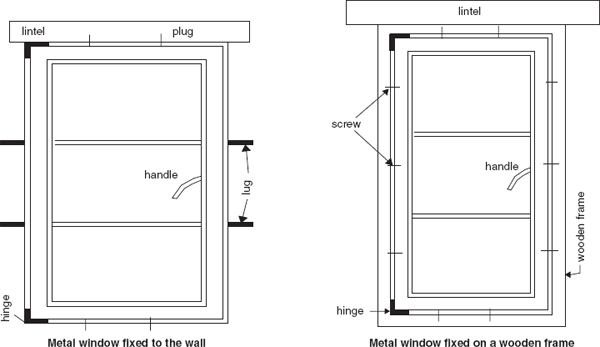
Figure 17.12 Metal window
17.5.6 Sliding window
This window works exactly on the same principle as sliding doors. It is made of shutters, which move horizontally or vertically on small roller bearings. Suitable openings or cavities are provided in the frame or walls to receive the shutters when the windows are opened out. The windows of this type are commonly used in trains, buses and counter-windows.
17.5.7 Pivoted window
In such type of windows, shutters swing around pivots. It may be horizontally pivoted or vertically pivoted. Such windows are easier to clean and they allow more light to come inside the room. The frame of this type of window is similar to that of a casement window but no rebates are made in the frame (Figure 17.13).
17.5.8 Bay window
It is a window in the building which is projected beyond the walls of the room. It is provided to improve the architectural appearance of the building. Additional space is obtained to allow light and air into the room.
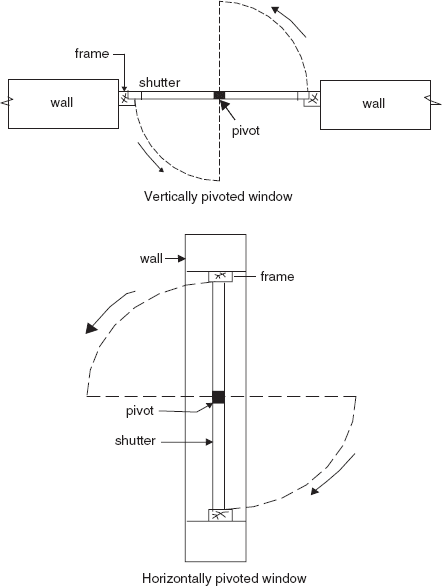
Figure 17.13 Pivoted window
17.5.9 Clere-story window
This window is usually provided near the top of the main roof and is made to open to the adjoining verandah or lean to the roof. This window is made to swing on two horizontal pivots provided in the side stiles. The shutter of the window is opened or closed by means of two cords, one from the top rail and the other from the bottom. It should be noted here that the upper part of the shutter opens to the inside of the room and the lower part opens outside. This is essential to exclude the rainwater (Figure 17.14).
17.5.10 Corner window
As the name implies, this type of window is placed in the corner of a room in a building. This window provides light and ventilation from two directions at right angles to each other and improves the appearance of the building (Figure 17.15).
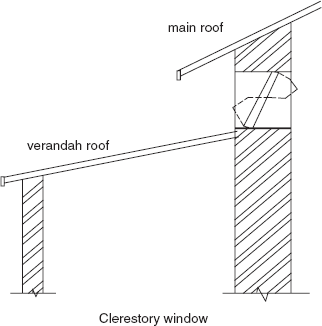
Figure 17.14 Clere-story window
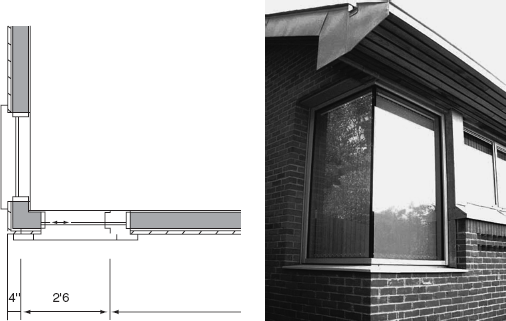
Figure 17.15 Corner window
17.5.11 Dormer window
These are the vertical windows built on the sloping sides of a pitched roof. These windows are provided to admit light and air to the rooms or the enclosed space below the roof slopes. These windows add to the appearance of the building (Figure 17.16).
17.5.12 Lantern light
Sometimes, the light entering from the windows in the walls is inadequate. In this case, some more windows are provided on the flat roofs to admit more light into the room. This type of window is known as lantern. It may be curved, rectangular or square. Generally, glass panels are used to cover the sides of the lantern. Pivoted shutters may be used when it is desired to admit air and light (Figure 17.17).
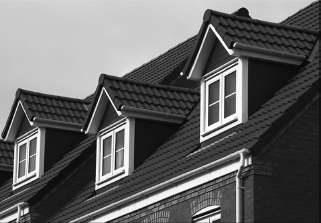
Figure 17.16 Dormer window
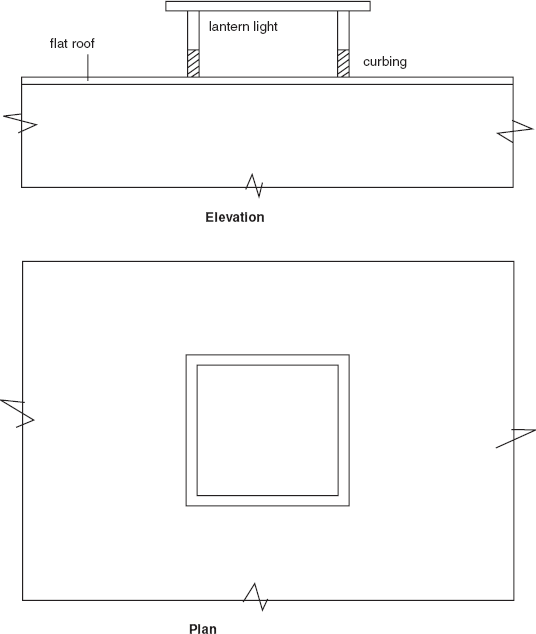
Figure 17.17 Lantern light
17.5.13 Sky light
This type of window is fixed on the sloping surface of an inclined roof. It is meant to admit light into the room and generally is fixed with glass panes to cover it. Reinforced or ribbed glass is preferred. A curb frame is provided with the common rafter to support the window (Figure 17.18).
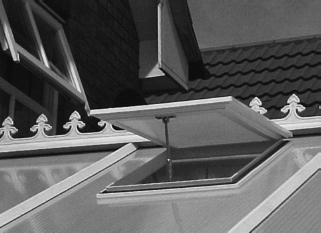
Figure 17.18 Sky light
17.5.14 Circular window
It is a window which is circular in shape and pivoted on the central axis. It is opened and closed by means of two cords, like clere-story windows. These windows are commonly used in factories and lofty rooms for admitting light and air (Figure 17.19).
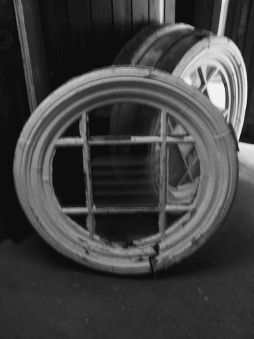
Figure 17.19 Circular window