Wood from freshly felled trees cannot be used in construction because it contains more moisture and is undesirable in many accounts. The water is to be removed before the timber can be used for any engineering purpose. This process of drying out the timber is known as seasoning of timber and the moisture should be extracted during seasoning under controlled conditions at a uniform rate from all parts of the timber. The remaining moisture, which cannot be extracted, should be uniformly distributed throughout the mass. The major objectives of seasoning are as follows:
- To reduce the weight of the timber.
- To increase the strength, stiffness and durability of the timber.
- To make the timber easily workable.
- To reduce the tendency of timber to crack, shrink and warp.
- To allow the timber to burn readily if used as a fuel.
- To make the timber fit for receiving treatment of paints, varnishes, etc.
- To make the timber safe from the attack of fungi and insects.
7.4.1 Methods of seasoning
The two main methods of seasoning of wood are
- Natural seasoning
- Artificial seasoning
7.4.1.1 Natural seasoning
In this method, the seasoning of timber is carried out by natural air and, hence, it is referred to as air seasoning. Stacking of timber is done very carefully as to allow free circulation of air between the individual pieces. The length of stack is equal to the length of timber pieces. The stack is to be protected from fast blowing wind, rain and extreme heat. Hence, a roof of suitable material should preferably cover the stack. Loss of moisture from wood is by the simple process of evaporation.
This method of seasoning is cheap and simple and does not require skilled supervision, but the drying of different surfaces may not be even and uniform. The process is very slow and may take 1–4 years before the timber is properly seasoned.
7.4.1.2 Artificial seasoning
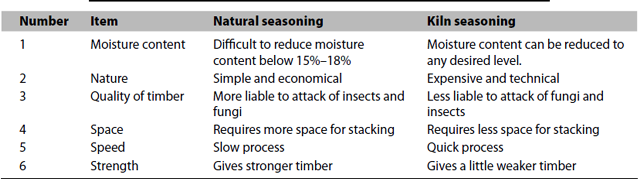
In artificial seasoning, the drying of different surfaces is even and uniform and it reduces the period of seasoning. Table 7.1 shows the comparison between natural and kiln seasoning. The various methods of artificial seasoning are as follows.
Table 7.1 Comparison Between Natural and Kiln Seasoning
- Boiling: In this method, the timber is immersed in water and the water is then boiled. This is a very quick method, but it affects the elasticity and strength of wood and also this method proves to be costly.
- Chemical seasoning: In this method, the timber is immersed in a solution of suitable salt. It is then taken out and seasoned in the ordinary way. Here the chances of formation of external cracks are reduced.
- Electrical seasoning: In this method, high-frequency alternating current is used. This is the most rapid method of seasoning, but it is uneconomical as the initial and maintenance cost is very high.
- Kiln seasoning: In this method, the drying is carried out inside an airtight chamber or oven. Depending upon the mode of construction and operation, the kilns are of two types, namely, stationary kilns and progressive kilns.In a stationary kiln, the process of seasoning is carried out in a single compartment only. This kiln is adopted for seasoning timber, which requires a close control of humidity and temperature. It gives better results. In a progressive kiln, the carriage with timber sections travels from one end of the kiln to the other and the hot air is applied from the discharging end. It is used for seasoning timber on a large scale.
- Water seasoning: This is a quick method and removes organic materials contained in the sap of timber. It, however, weakens the timber and makes it brittle.