Introduction
A single quadrat is just a simple range of fields in which a certain range of plants is planted. In utilizing the quadrat method, the specialty of considering a quadrat in this measurement process is very important. Each of the quadrats possesses a specific shape and size. In measuring the exact amount of a plant’s community value, the quadrat method of plant population density is the most applicable one. Also in relation to ecology, the quadrat method is the most applicable and suitable one for measuring the exact value of any plant’s population.
What is the Quadrat Method?
The relevance of a quadrat method is widely found in relation to the measurement procedure of any plant’s population frequency. The calculation of a huge bunch of any particular plant species is very difficult at a certain time. The range of time, being limited, can present challenges in this measurement process. Therefore, the quadrat method is the most applicable and easiest one for measuring the density of any particular plant species by which the species of a particular area (habitat) are counted directly.
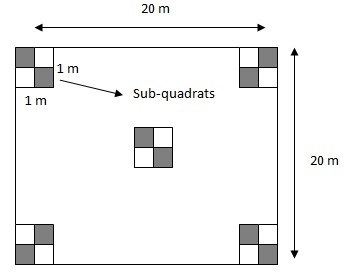
Figure 1: A sample of a quadrat grid
Quadrat sampling is an important and integral part of generating information about the plant habitat. This process is estimated in relation to the abundance of a plant’s population. All the density, distribution, and frequency value of the plants can be measured by considering all the associated concerns.
Explore our latest online courses and learn new skills at your own pace. Enroll and become a certified expert to boost your career.
Frequency Value of Plant Population
Measurement of plant frequency and biomass is done based on each specification and characteristic value of quadrats. The frequency value of a quadrat indicates the range at which, a specific plant species are planted in a certain range area. The frequency of the plant’s repetition in a particular range of fields is associated with this. The concerned plant species for a particular study is associated with the generation of this value. Therefore, it can be stated that the most appropriate value of any specific plant’s frequency is fully dependent on the different sizes and individual shapes of each quadrant. All the quadrat positions and measurements are decided randomly. All of these samplings are paced along with a specific transect.
Aim of the Experiment
The main aim of this specific experiment is to study plant population density with the help of a quadrat method.
Required Materials
In this study, only three materials are required and these are as follows.
- Thread
- Nail
- Hammer
Procedure
In executing the whole experiment, certain measures are to be followed.
- The investigation area is to be selected at the very first stage. The firm vegetation is to be ensured as well.
- In making a square at that place, a measurement of 1m * 1m dimensions is to be granted. At the four corners of that measured place, four nails are put.
- This measured place is bounded with a thread and the structure of a square by taking the help of these nails.
- This same procedure is followed in making nine more quadrats.
- A specific plant species is selected for this experiment.
- That specific species can be provided with a relevant name.
- All the specimens of this species are placed into all the ten quadrats and arranged in a table format.
- A second and third option of plant species is to be selected after that and placed in the same manner.
- In measuring the frequency of each significant plant population, a formula can be used.
- The formula is
Percentage Frequency = (Number of sampling units in which the species occurs) / (Total number of sampling units, employed for the study) * 100.
Observation
In understanding the density of plant population, the number of arranged trees can be considered important. The observation can present that the first considered sample plant possesses a high-frequency rate. In that exact amount of space, a high number of plant species indicated a high-frequency rate. Whereas, in case the other species are low in number, the frequency rate in quadrat is low. The highest frequency rate of any of the three selected plants can be easily observed by this measurement.