12.2.1 Building line and control line
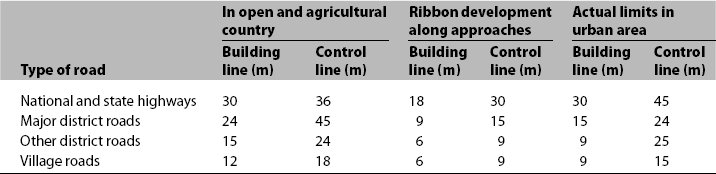
The ‘building line’ refers to the line of building frontage, i.e., the line up to which the plinth of the building adjoining the street or an extension of street or on a future street may lawfully extend. This line is often known as set back or front building line and is laid down in each case, parallel to the plot boundaries, by the authority, beyond which nothing can be constructed towards the plot boundaries. Certain buildings, such as factories and business centres that attract large number of vehicles, should further set back a distance apart from the building line. The line that accounts for this extra margin is known as ‘control line’(Table 12.2).
Table 12.2 Distances of Building Lines and Control Lines
12.2.2 Built-up area
The built-up area of a plot means the plot area minus the area of open spaces in it (Table 12.3).
12.2.3 Open space requirements
For attaining natural ventilation, open spaces are necessary around the building. As per the Kerala Building Rules 1984, the minimum open space requirements are given as below.
- For buildings upto 10 m height.
- Every building shall have at least front and backyards of a minimum of 3 m.
- A clear open space of not less than 1.5 m shall be there on the sides other than front and rear.
- For buildings above 10 m and upto 25 m height, there shall be an increase in the minimum open spaces at the rate of 0.5 m per every 3 m exceeding 10 m or fraction of it.
12.2.4 Size of the rooms
The minimum area required for the individual rooms is also specified. For example, the minimum area required for a kitchen is specified as 4.5 m2. The bathroom is to have a minimum size of 1.5 m × 1.2 m or an area of 1.8 m2, while a combined bathroom and water closet is to have a minimum floor area of 2.8 m2, with a minimum width of 1.2 m.
The minimum height of an individual room is specified as (i) 2.75 m for habitable rooms, (ii) 2.2 m for bathrooms and WC and (iii) 2.55 m for kitchens. The specifications for maximum height of buildings are given in Table 12.4.
Table 12.3 Limitation of Built-up Area for Residential Buildings
| Area of plot (m2) | Maximum permissible built-up area |
|---|---|
| Less than 200 | 60% with two-storeyed structure |
| 200–500 | 50% of the site |
| 500–1,000 | 40% of the site |
| More than 1,000 | 33.33% or 1/3rd of the site |
Table 12.4 Maximum Height of Buildings
| Width of street (m) | Height of the building |
|---|---|
| Say W | Height = 1.5 W + front open space |
| Upto 8 | 1.5 times the width of street |
| 8–12 | Not more than 12 m |
| Above 12 | Not more than the width of street and in no case more than 24 m |
12.2.5 Lighting and ventilation of rooms
The aggregate area of doors and windows is to be not less than one-fourth of the room area. The total area of windows is to be one-tenth of the floor area for dry hot climate and one-sixth of the area for wet climate.
In addition to the above, ventilators are to be provided for at least 0.3 m2 area or at the rate of 0.1 m2 for every 10 m3 of space.
The depth of the foundation is to be 0.7–1 m below the finished ground for single-storeyed buildings and for double-storeyed buildings it is to be 1–1.3 m. The plinth of the building is to be kept higher than the surrounding ground level by 30 cm or greater.