A building broadly consists of three parts:
- Foundation
- Plinth
- Superstructure
12.1.1 Foundation
The foundation is the most critical part of any structure and most of the failures are probably due to faulty foundations. Hence, it is highly essential to secure good foundation to maintain the stability of the structure. A good foundation must remain in position without sliding, bending, overturning or failing in any other manner.
The foundation of any structure should be laid much below the surface of the ground in order to attain the following:
- To secure a good natural bed.
- To protect the foundation courses from atmospheric influences.
- To increase the stability of the structure against overturning due to wind uplift.
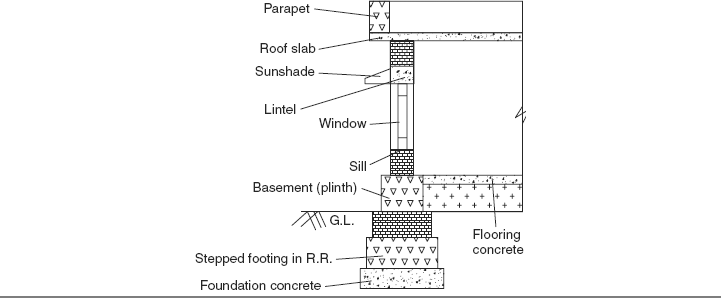
Figure 12.1 Section of a building showing various components
The primary function of the foundation is to transmit the anticipated loads safely to the soil below. The foundation in a building structure is supposed to satisfy the following basic requirements in their design and construction:
- To distribute the total load coming on the structure over a large bearing area so as to prevent it from any movement.
- To load the bearing surface or area at a uniform rate so as to prevent it from any movement.
- To prevent the lateral escape or movement of the supporting material or alternatively to ensure the stability of the structure against sliding.
- To secure a level or firm natural bed upon which to lay the course of masonry and also support the structure.
- To increase the stability of the structure as a whole to prevent it from overturning or sliding against the disturbing forces such as wind, rain and frost.
12.1.2 Plinth
This is the portion of the structure between the surface of the surrounding ground and the surface of the floor immediately above the ground. The thickness of the plinth wall depends upon the weight of the superstructure and the width of the foundation concrete. The minimum height of the plinth is usually kept as not less than 4.5 cm.
The plinth wall should satisfy the following requirements in a building structure in its design and construction:
- To transmit the load of the superstructure to the foundation.
- To act as a retaining wall so as to keep the filling in position below the raised floor or the building.
- To protect the building from dampness or moisture.
- To enhance the architectural appearance of the building.
12.1.3 Walls and piers in superstructure
The primary function of the wall is to enclose or divide space. Piers are usually in the form of a thickened section of a wall, placed at intervals along the wall to take concentrated vertical loads or to provide lateral support to the wall. These walls may be built of different materials such as brick or stone masonry, plain concrete and reinforced masonry.
A load-bearing wall should satisfy the following requirements:
- Strength: A wall should be strong enough to take up the loads safely. The loads coming in the wall include its own weight, weight by superimposed loads and bilateral pressures like wind.
- Stability: It should be stable against overturning by lateral forces and buckling caused by excessive slenderness.
- Weather Resistance: All the external walls whether load bearing or panel constructions should provide adequate resistance to rain, sun and wind.
- Fire Resistance: The walls should offer sufficient resistance to fire as they behave as vertical barriers for spread of fire in the horizontal direction.
- Heat Insulation: It should be possible for walls to attain insulation against heat.
- Sound Insulation: The walls should be made of such materials and by such technique so as to insulate the building against sound.
- Privacy and Security: The walls should provide sufficient privacy and afford security against theft.
12.1.4 Floors
The main function of a floor is to provide support for occupants, furniture and equipment of a building, and the function of providing different floors is to divide the building into different levels for creating more accommodation within the limited space (Table 12.1).
A floor should satisfy the following requirements:
- Strength and Stability: All the floors, whether basement, ground or upper should be strong enough to support the floor covering and other superimposed loads.
- Durability and Damp Prevention: The floors provide a clean, smooth, impervious, durable and wear-resisting surface.
- Heat Insulation: Insulation against heat should be provided in case of ground and basement floors, especially when suspended and ventilated timber floors are used.
- Sound Insulation and Fire Resistance: The insulation against sound and fire should be provided in the case of upper floors as they act as horizontal barriers for the passage of sound and fire in a vertical direction.
Table 12.1 Criteria for Calculating Floor Areas and Height of Structures
| Type of building | Cubic contents per capita (m3) | Floor area per capita (m3) |
|---|---|---|
| Residential buildings | 9 | 2.5–9 |
| Dormitories | 12–15 | 3-4 |
| Educational buildings | 4.5–7.5 | 1-2 |
| Institutional buildings | 30 | 8–10 |
| Industrial buildings | 7.5 | 2–2.5 |
12.1.5 Doors and windows
The main function of doors in a building is to serve as a connecting link between internal parts and to allow free movement to the outside of the building. Windows are generally provided for proper ventilation and lighting and their number should be determined according to the requirements.
Doors and windows should satisfy the following requirements:
- Weather Resistance: They should be strong enough to resist the adverse effects of weather.
- Sound and Thermal Insulation: They should be capable of being made air tight to achieve insulation against sound and heat.
- Damp Prevention and Termite Prevention: They should not be affected by white ants and the moisture penetration as this will reduce the strength and durability.
- Fire Resistance and Durability: They should offer fire resistance and should be durable.
- Privacy and Security: They should offer sufficient privacy without inconvenience or trouble and security against theft.
12.1.6 Sills, lintels and weather shades
Window sills are provided between the bottom of the window frame and the wall below to protect the top of the wall from wear and tear. The openings are provided in the wall of a building to accommodate the doors and windows. The actual frame of a door or window is not strong enough to support the weight of the wall above the opening and a separate structural element is, therefore, introduced between the top of the window frame and the wall coming over it. This is known as the lintel. Weather shades are generally combined with lintels of windows to protect them from the weathering agencies.
12.1.7 Roofs
A roof is the uppermost part of a building whose main function is to enclose the space and to protect the same from the effects of weather elements. A good roof is just as essential as a safe foundation. As a well-designed foundation secures the building against destruction starting at the bottom, similarly a good roof affords protection for the building itself and what the building contains and prevents destruction from the top.
A roof should satisfy the following requirements:
- Strength and Stability: The roof structure should be strong and stable enough to take up the anticipated loads safely.
- Weather Resistance: The roof covering should have adequate resistance to resist the effects of weather elements.
- Heat Insulation: The roof should provide adequate insulation against heat.
- Sound Insulation: The roof should have adequate insulation against sound from external sources.
- Fire Resistance: The roof should offer an adequate degree of fire resistance in order to give protection against the spread of fire from any adjacent buildings and to prevent early collapse of the roof. The form of construction should also be such that the spread of fire from its source to other parts of the building by way of roof cannot occur.
- Day Lighting: The roof provides daylight in buildings with large floor area.
12.1.8 Steps and stairs
A step usually consists of a tread and riser supported by strings. A stair is a structure consisting of a number of steps leading from one floor to another. Location of stairs in all types of residential and public buildings should be such as to afford the easiest and quickest service possible to the building. The main function of the stairs is firstly to provide a means of communication between the various floors. Secondly, it also acts as an escape from the upper floors in the event of fire.
Steps and stairs should satisfy the following requirements:
- Strength and Stability: The stairs should be designed like floors such that they are strong and stable enough to carry the anticipated loads safely due to the weight of the people using them and also the weight of the furniture or equipment being carried up or down through them.
- Fire Resistance: The stairs should be made of fire-resisting material and should be connected to different floors, such that they provide safe means of escape in the event of fire.
- Sound Insulation: The stairs should have adequate insulation against sound from external sources.
- Weather Resistance: The stairs if exposed to open air should offer sufficient resistance to weather elements such as rain and heat.
- Comfort: The proper design of steps and proper location of stairs in a building offer several advantages such as comfort and efficiency in vertical movement, natural light and ventilation and safety in emergency.
12.1.9 Finishes for walls
Finishes of several types such as pointing, plastering, painting and distempering and decorative colour washing are applied on the walls. The main functions of these finishes are as follows:
- They protect the structure, particularly the exposed surfaces, from the effects of weather.
- They provide a true, even and smooth finished surface and also improve the aesthetic appearance of the structure as a whole.
- They cover up the unsound and porous materials used in the construction.