3.3.1 Calcination
Lime is manufactured by the burning of limestone to bright red in suitable kilns or clamps. Theoretically, limestone dissociates when heated at 880°C into carbon dioxide and calcium oxide, which is also reversible.
CaCO3 ↔ CaO + CaO2
The burning or calcination of limestone can be carried out in one of the following ways:
- Clamps
- Kilns
- Intermittent kilns
- Continuous kilns
3.3.1.1 Clamp burning
It is a very common and quick method of obtaining small supplies of ordinary type of quick lime. No constructions have to be made. Simply the ground is levelled and cleaned and the limestone and fuel are stocked in alternative layers, if the fuel is wood. But if the fuel is coal or charcoal, the limestone and fuel are mixed together and placed in a heap form. Any type of burning material locally available is used. The whole heap is then covered with mud plaster and an attempt is made to preserve as much heat as possible. Small holes are left at the top of the plaster and also at the bottom. When the blue flame at the top disappears, it indicates the completion of the burning of lime. The clamp is then allowed to cool and the pieces of quick lime are hand-picked subsequently. Even though burning is quick and cheap for ordinary type of lime, it is not suitable for large supplies because of the following reasons:
- It proves to be uneconomical to manufacture lime on a large scale.
- The burning is not complete which results in poor quality lime containing unburnt limestone.
- Wastage is considerable, both in terms of heat generated and material produced.
- The quantity of fuel required is more and hence can only be practised where fuel is abundant (Figure 3.1).
3.3.1.2 Kiln burning
Most of the commercial lime is made by burning limestones in permanent structures called kilns. Kilns used in the manufacture of lime are of a number of variety and designs. A kiln may be of intermittent or continuous type. The kiln may be mixed feed type where the fuel and limestones are mixed up during burning. In separate feed type, the fuel is burnt separately and does not come into contact with the limestones.
Intermittent kilns
This is also known as batch type kiln. They are permanent structures of rectangular, oval or cylindrical shape. It may be made of bricks or stones. The interior of this kiln is lined with refractory bricks and does not break even at high temperatures. The kiln is provided with openings or flues for supply of air during burning. The roof may be covered or partly covered. An escape hole for gases is always provided at the top.
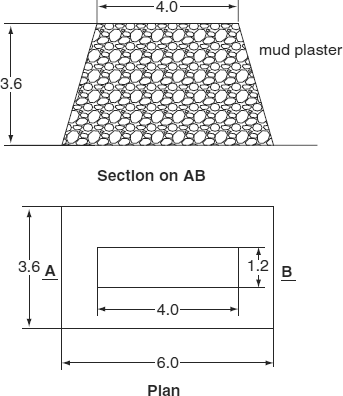
Figure 3.1 Clamp
In mixed feed type, the kiln is first loaded with a calculated amount of fuel and limestone, being deposited in alternative layers. The top of the kiln is covered with unburnt material. The kiln is ignited from the bottom for a required number of days till calcination is complete. It is allowed to cool and then unloaded. The next batch of fuel and limestone is charged to repeat the process (Figure 3.2).
In separate feed type, the fuel is not allowed to come in contact with the limestones. Bigger pieces are stocked in lower regions and smaller pieces above them, leaving open spaces for circulation of hot gases. Fuel is burnt in arch-type gates from where the hot gases rise and circulate between the limestones. When the limestones are sufficiently burnt, the kiln is cooled and unloaded. In this process the burning is more complete and mixing of ash and lime is avoided. There is a considerable wastage of lime in intermittent kilns as every operation includes loading, burning, cooling and unloading.
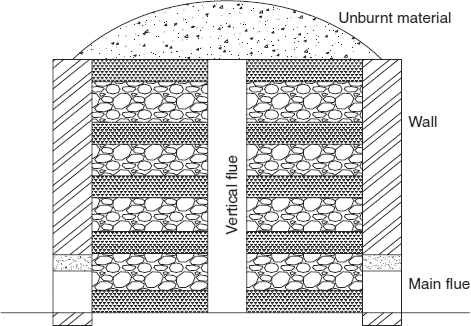
Figure 3.2 Intermittent flame kiln
Continuous kilns
These kilns are of such designs that from one end they are charged with raw materials and from the other end finished materials are taken out. Consequently, the kiln is not stopped for emptying or cooling operations. Naturally, the rate of production of lime is much higher.
In continuous flame kiln or mixed feed continuous kiln, the mixture of limestone and fuel is fed from the top. The widening of the middle portion is done so as to accommodate the hot gases of combustion. The bottom is covered by grating with holes. After burning, the lime is collected at the bottom and removed through the access shaft. The kiln is partly under the ground and partly above the ground. The inside surface of the kiln is covered with fire brick lining. The loading platform is provided at the top. As the level of material falls, the required amount of the mixture of fuel and limestone is fed from the top.
In continuous flare kiln or separate feed continuous kiln, the fuel is not allowed to come in contact with the limestone. The kiln consists of two sections. The upper section serves for the storage of limestones. The lower portion is provided with fire brick lining. Initially, a small quantity of fuel is mixed with limestone and ignited. The fuel is then fed through shafts around the lower and upper section of the kiln. The feeding of limestone is from the top. The removal of the calcinated material is done through a grating placed at the bottom of the kiln from where it can be removed (Figure 3.3).
There is a considerable saving in time and fuel, but the initial cost is high. Hence, this method can be adopted to manufacture lime on a large scale.