The process of mixing water in quick lime is known as slaking of lime. It is an important operation in the preparation of lime at site for use in building construction. Improper slaking results in serious defects in mortars and plasters.
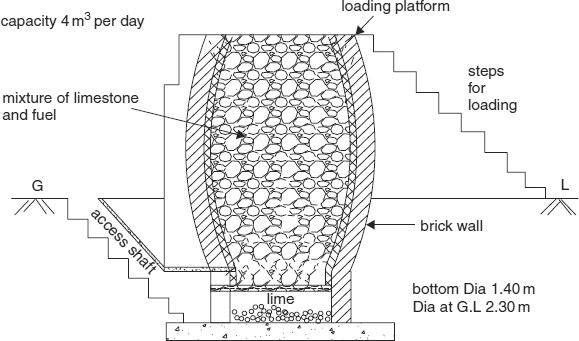
Figure 3.3 Continuous flare kiln
Two methods are commonly used for slaking of lime.
3.4.1 Tank slaking
In this method, two brick lined tanks are required. The first tank is about 45 cm deep and is made at a higher level, whereas the second tank is 60–75 cm deep and is made at a lower level, adjoining the first tank. Water is filled in the upper tank to about three-fourth its depth and quick lime is gradually added to it in small amounts. Water is constantly stirred during the process of addition of lime. This results in the formation of ‘milk of lime’, which is allowed to fall through a sieve into the lower tank.
After the lime-milk has been allowed to stand for the requisite time (2-3 days), it matures itself and forms lime putty, which is taken for use.
3.4.2 Platform slaking
The method provides dry slaking of lime which can be used as it is or may be converted to putty. A watertight masonry platform is built, over which the lime is spread in a 15 cm layer. Water is then sprayed over it using a hose pipe till lime disintegrates into a fine powder. During the water sprinkling process, the lime heap is turned over and over again. It is then left for 24 hours during which further slaking occurs.
The rate of hydration or slaking is greatly a function of the composition, physical state and degree of burning of lime. It is to be noted that over-burnt or under-burnt limestones do not slake easily. Hence, such undesirable pieces should be removed before slaking. It is also necessary to convert all lumps into powder or pulp form. It is observed that one part of fat quick lime is converted into about 1½ parts in paste form and about 2 parts in powder form.
The quantity of water required for hydrating 100 kg of lime is 32 litres, but practically even 100 litres of water may have to be added. This is generally determined by experience and depends on other factors like composition of quick lime, method of slaking and the form in which hydrated lime is required, i.e., either as putty or powder form.