When concrete is placed, it is in plastic state. It requires to be supported by temporary supports and casings of the desired shape till it becomes sufficiently strong to support its own weight. This temporary casing is known as the formwork.
16.11.1 Requirements of a good formwork
- Easy removal: The design of formwork should be such that it can be removed easily with least amount of hammering. This will also prevent the possible injury to the concrete, which has not become sufficiently hard. Further, if the removal of formwork is easy it can be made fit for reuse with little expenditure. The operation of removing the formwork is commonly known as stripping, and when stripping takes place, the components of the formwork are removed and then reused for another part of the structure. Such forms whose components can be reused several times are known as panel forms.
- Economy: It is noted that the formwork does not contribute anything to the stability of the finished structure, and hence it will be desirable to bring down its cost to a minimum, consistent with safety. The various steps such as reduction in the number of irregular shapes of forms, standardizing the room dimensions, use of component parts of commercial size and putting the formwork in use again as early as possible may be taken to affect the economy in the formwork. The formwork should be constructed of that material which is easily available at low cost and which can safely be reused several times.
- Less Leakage: The formwork should be so arranged that there is minimum leakage through the joints. This is achieved by providing tight joints between sections of the formwork.
- Quality: These forms should be designed and built accurately so that the desired size, shape and finish of the concrete are attained.
- Rigidity: The formwork should be rigid enough to retain the shape without any appreciable deformation. For visible surfaces in the completed work, the deflection is limited to 1/300 of span and that for hidden surface is limited to 1/150 of span. It should be noted that a rigid formwork would be robust and stiff enough to allow repeated use.
- Smooth Surface: The inside surface of formwork should be smooth to turn out a good concrete surface. This is achieved by applying crude oil or soft soap solution to the inside surface of formwork. This also makes the removal of formwork easy.
- Strength: The formwork should be sufficiently strong enough to bear the dead load of wet concrete as well as the weights of equipments, labour, etc. required for placing and compacting the concrete. This requires careful design of the formwork. The overestimation of loads results in expensive formwork and the underestimation of loads results in the failure of formwork. The loads on vertical forms are to be assessed from various considerations such as density of concrete, dimension of section, concrete temperature, slump of concrete, reinforcement details, stiffness of forms and rate of pouring of concrete.
16.11.2 Steel formwork
Steel is used for formwork when it is desired to reuse the formwork several times. The initial cost of steel formwork is very high. However, it proves to be economical for large work requiring many repetitions of the formwork. The erection and removal of steel formwork are simple and it presents a smooth surface on removal.
16.11.2.1 Advantages
- It can be reused several times, nearly ten times more than timber formwork.
- It does not absorb water from concrete and, hence, the chances of formation of honey-combed surface are brought down to the minimum level.
- It does not shrink or distort and, hence, it is possible to achieve higher degree of accuracy and workmanship by its use as compared to timber formwork.
- It is easy to install and dismantle and, hence, there is saving in the labour cost.
- It gives excellent concrete surfaces requiring no further finishing treatment. The surface obtained by the use of timber formwork invariably requires plastering for getting the desired finish of the concrete surface.
- It possesses more strength and is more durable than timber formwork.
- The design calculations for the steel formwork system can be made precisely because of the known characteristics of steel.
16.11.3 Timber formwork
When formwork is required for small works requiring less repetition, timber is preferred to steel. Timber formwork is cheap in initial cost and it can be easily adopted or altered for new use. The timber to be used as formwork should be well seasoned, free from loose knots, light in weight and easily workable with nails without splitting.
- The timber formwork should be neither too dry nor too wet. If it is too dry, the timber will swell and get distorted when wet concrete is laid on it and honey-combed surface will appear on removal of the formwork. On the other hand, if it is too wet, the timber will shrink on hot weather resulting in gaps in the formwork through which concrete will flow out. Hence, ridges will be formed on the concrete surface. It is found that a moisture content of about 20 per cent is appropriate for the timber formwork.
- The dimensions of components of the timber formwork will depend upon the loads to be carried and the availability of timber sections. However, generally the latter is the governing factor as the former can be adjusted by suitable spacing of the supports.
- Minimum number of nails should be used in timber formwork and the nail heads should be kept projecting so as to facilitate easy removal.
- The timber formwork proves to be economical for buildings with minimum number of variations in the dimensions of the rooms. Thus, the cutting of timber pieces is brought down to the minimum.
- It is common practise to support formwork for slab in buildings with the timber ballies, which are cut to approximate sizes with wedges below them for final adjustments. It leads to the formation of weak points, which are seldom prevented from displacement. The timber ballies are generally not straight and they do not transmit the load axially.
Plywood as formwork is becoming popular at present over the timber formwork because:
- It can be reused several times as compared to ordinary timber formwork. Under normal conditions the plywood formwork can be used 20–25 times and the timber formwork can be used 10–12 times.
- It gives surfaces which are plain and smooth and, hence, it may not require any further finishing treatment.
- It is possible to cover up more area by using large size panel and, hence, there is considerable reduction in the labour cost of fixing and dismantling formwork.
16.11.4 Failures of formwork
Safety must be given importance in the design, construction, erection and stripping of formwork systems. The general rules to be observed to avoid the failure of formwork for concrete structures are as follows:
- If high shoring is not suitably strengthened by diagonal braces, there are chances for formwork failure to occur.
- It should be remembered that the forms are continuously supported structures and as such they must be provided with uniform bearing at each support.
- The entire work should be carried out under the strict and direct supervision of skilled persons or engineers only.
- The design of formwork should provide for possible shocks and vibrations.
- The details that are difficult to perform should be avoided as in many cases such details will not be satisfactorily performed and may become the starting point for causing a formwork failure.
- The stripping of form and reshoring should not be carried out in an unbalanced way. It will otherwise lead to unnecessary stresses in freshly laid concrete.
- The wedging of posts to counterbalance load compression must be carried out with extreme care so that the assembled form support remains undisturbed.
16.11.5 Formwork for columns
The column formwork consists of a box prepared for four separate sides (Figure 16.4). The four sides of the box are held in position by wooden blocks, bolts and yokes. The important features in the RCC column are:
- The formwork should be designed to resist the high pressure resulting from the quick filling of the concrete.
- The spacing of yokes is about 1 m. However, it should be carefully determined by working out the greatest length of the formwork, which can safely resist the load coming on the formwork.
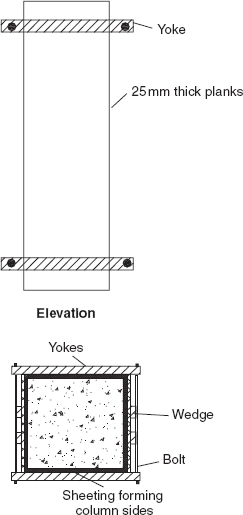 Figure 16.4 Wooden formwork for rectangular or square column
 - Depending upon the shape of the column, the box can be suitably prepared.
- A hole is generally provided at the bottom of the formwork of column to remove the debris, which might have fallen before the concrete is placed. This hole is termed as the cleanout hole or washout hole and it is filled up before the placing of the concrete starts.
- A wash with water is given to the inside of the formwork just before starting the laying of concrete.
- The boxes should be designed in such a way that with little alterations they can be reused for columns with smaller cross sections on upper floors.
- In order to make the dislocation of boxes easy, the nails are kept projecting instead of being firmly driven. Thus, they can be removed easily by the claw hammer.
- The wooden yokes being efficient and cheap are wisely used, but they can be replaced by metal clamps of suitable design.
- The formwork for circular columns is made of narrow vertical boards. These are known as the staves and they are correctly shaped to the required curvature. The staves in turn are fixed to the yokes, which are also suitably curved.
16.11.6 Formwork for walls
The formwork for walls consists of sheets, studs, ties and braces. The sheets are supported by vertical studs and horizontal wales. The ties are provided to maintain the distance between the sheets and to resist the bursting action of concrete. Small pieces of timber known as spacers may be used and they are to be removed as the concrete reaches that level. In addition, wire ties and bolts may be provided. The wires are placed at a horizontal distance of about 600 mm and they are taken round the wales. When formwork is struck off, the ends of wire ties are cut off and provided with rich quality of cement mortar to avoid rusting. If bolts are used, they are to be provided with grease or embodied in cardboard tubes to make their removal easy after 2 or 3 days of pouring concrete (Figure 16.5). The points to be remembered in the case of formwork for walls are as follows:
- The braces may be provided at a horizontal distance of about 2 m and they are supported at ground level by stakes firmly driven into the ground.
- If the wall is high, the formwork is to be supported on either side by guy wires instead of braces.
- Several patent devices have been found out to keep the sheets in the correct position. They can be used in place of wire ties and bolts.
- The reinforcement, if any, is to be properly placed in position before the laying of concrete starts.
- The various components of the formwork should be properly designed.
- The formwork should be cleaned and washed with water before laying concrete in it.
- If the vertical height of the wall is 3 m or more, the wall is prepared in vertical lifts of about 1 m height. The braces are avoided and the lower completed concrete wall works as a platform for the upper portion. This type of formwork is sometimes referred to as the climbing formwork (Figure 16.5).
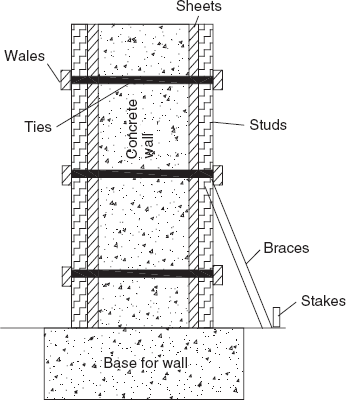
Figure 16.5 Formwork for wall
16.11.7 Stripping time of formwork
In normal circumstances and where Ordinary Portland Cement is used, forms may generally be removed after the expiry of the following periods.
| a. Walls, column and vertical faces on all structural members | 24–48 hours as may be decided by the engineer-in-charge |
| b. Slabs (props left under) | 3 days |
| c. Beam soffits (props left under) | 7 days |
| d. Removal of props under slabs: | |
| 1. Spanning up to 4.5 m | 7 days |
| 2. Spanning over 4.5 m | 14 days |
| e. Removal of props under beams and arches: | |
| 1. Spanning up to 6 m | 14 days |
| 2. Spanning over 6 m | 21 days |
For other cements, the stripping time recommended for Ordinary Portland Cement may be suitably modified.