13.4.1 Spread footing
This is the most common type of foundation and can be laid using open excavation by allowing natural slopes on all sides. This type of foundation is practicable for a depth of about 5 m and is normally convenient above the water table. The base of the structure is enlarged or spread to provide individual support. This type of footing is given for structures of moderate height built on sufficiently firm ground and for light structures. They have only one projection beyond the width of the wall on either side (Figure 13.2).
13.4.2 Stepped footing
Here, we have more than one projection on either side of the width of the wall as shown in Figure 13.3.
The depth of each layer is at least twice the projections and its base width should be twice the width of the layer above that. Generally, the projections provided are kept as 15 cm on either side. The depth is generally limited to 0.9 m in general cases.
13.4.3 Isolated and combined footing
They are used to support individual columns. They can be either of stepped type or have projections in the concrete base. In the case of heavy loaded columns, steel reinforcement is provided in both the directions in the concrete bed. Generally, 15 cm offset is provided on all sides of the concrete bed. In the case of brick masonry columns, an offset of 5 cm is provided on all the four sides in regular layers. The footing of concrete columns may be slab, stepped or sloped ones.
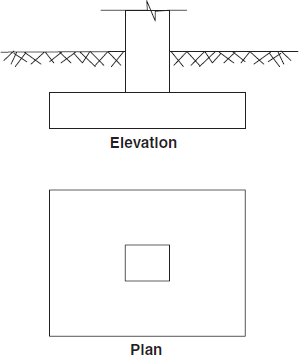
Figure 13.2 Spread footing
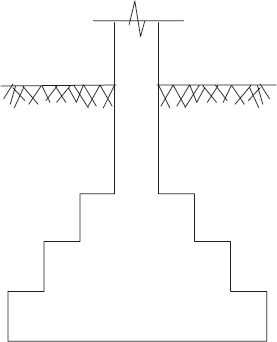
Figure 13.3 Stepped footing
A combined footing supports two or more columns in a row. The combined footing can be rectangular if both the columns carry equal loads or can be trapezoidal if there are space limitations and carry unequal loads. Generally, they are constructed of reinforced concrete (Figure 13.4).
13.4.4 Mat or raft foundation
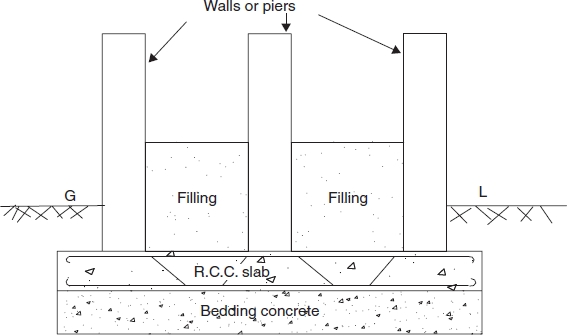
The raft or mat foundation is a combined footing that covers the entire area beneath the structure and supports the columns. If required the beam and slab construction in reinforced cement concrete (RCC) can also be carried out. When the allowable soil pressure is low or the structural loads are heavy, the use of spread footings would cover more than one-half of the area and it may prove more economical to use raft foundation. A raft may undergo large settlements without causing harmful differential settlement. For this reason almost double the settlement of that permitted for footings is acceptable for rafts. Usually, when hard soil is not available within 1.5–2.5 m, a raft foundation is adopted. The raft foundations are useful for public buildings, office buildings, school buildings, residential buildings, etc. (Figure 13.5).
13.4.5 Pile foundation
The pile foundation is a construction for the foundation supported on piles. A pile is an element of construction composed of timber, concrete or steel or a combination of them. Pile foundation may be defined as a column support type of foundation, which may be cast in situ or precast. The piles may be placed separately or they may be placed in the form of a cluster throughout the length of the structure. This type of construction is adopted when the loose soil extends to a great depth. The load of the structure is transmitted by the piles to the hard stratum below or it is resisted by the friction developed on the sides of piles.
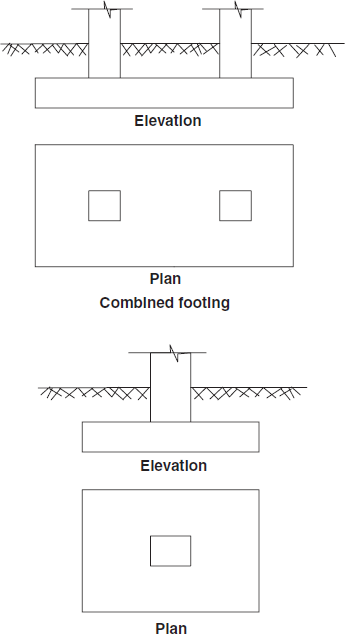
Figure 13.4 Isolated and combined footing
13.4.5.1 Classification of piles
Piles can be broadly classified into two categories.
Classification based on the function
- Bearing piles: These piles penetrate through soft soils and their bottom rests on a hard stratum. The soft ground through which the piles pass also gives lateral support and increases the load carrying capacity of the bearing piles.
- Friction piles: When loose soils extend to a great depth, piles are driven up to such a depth that frictional resistance developed at the sides of the piles equals the load coming on the piles.
- Screw piles: Screw piles consist of a hollow cast-iron or steel cylinder with one or more blades at the bottom. The blades are generally made of cast iron. The bottom end of the screw pile with a blunt point is useful when the ground to be penetrated consists of clay or sand.
- Compaction piles: They are used to compact loose granular soils in order to increase their bearing capacity. These piles do not carry any load.
- Uplift piles: These piles anchor down the structure subjected to uplift due to overturning movement.
- Batter piles: These are used to resist large horizontal or inclined forces.
- Sheet piles: These are used as bulk heads or as an impervious cut off to reduce seepage and uplift.
Classification based on materials and composition
- Cement concrete piles: Cement concrete piles possess excellent compressive strength. These piles can be reinforced or prestressed.
- Timber piles: Timber piles are prepared from trunks of trees. They may be circular or square. They are 30–50 cm in diameter with a length not exceeding 20 times its top width. At the bottom, a cast iron shoe is provided and at the top a steel plate is fixed. If a group of timber piles is driven, the top of each member of the group is brought at the same level and then a concrete cap is provided to have a common platform. It is difficult or even impossible to drive these piles into the hard stratum or boulders.
- Steel piles: The different forms of steel piles are H piles, box piles and tube piles. These piles can easily withstand the stresses due to driving.
- These piles can be easily lengthened by welding and also can be cut off easily.
- These piles can resist lateral forces in a better way.
- The bearing capacity of these piles is comparatively high.
- These piles can take up the impact of stresses and can resist lateral forces.
- Sand pile: These piles are made by boring holes on the ground and filling them with sand. The top of the sand piles is filled with concrete to prevent the sand from coming upwards due to lateral force. Sand piles are spaced 2-3 m and the length is about 12 times the diameter. Even though they are easy to construct and can be used irrespective of any position of water table, they are not suitable for earthquake regions.
- Composite piles: A composite pile is formed when it is a combination of piles of two different materials. They are suitable where the upper part of a pile is to project above the water table. They are economical and easy to construct.
13.4.6 Well foundations
These foundations are used in underwater constructions. They are foundations with a hollow portion. These are the most commonly used deep foundations, especially for structures like bridges. They are generally built of timber, metal, reinforced concrete, masonry, etc.